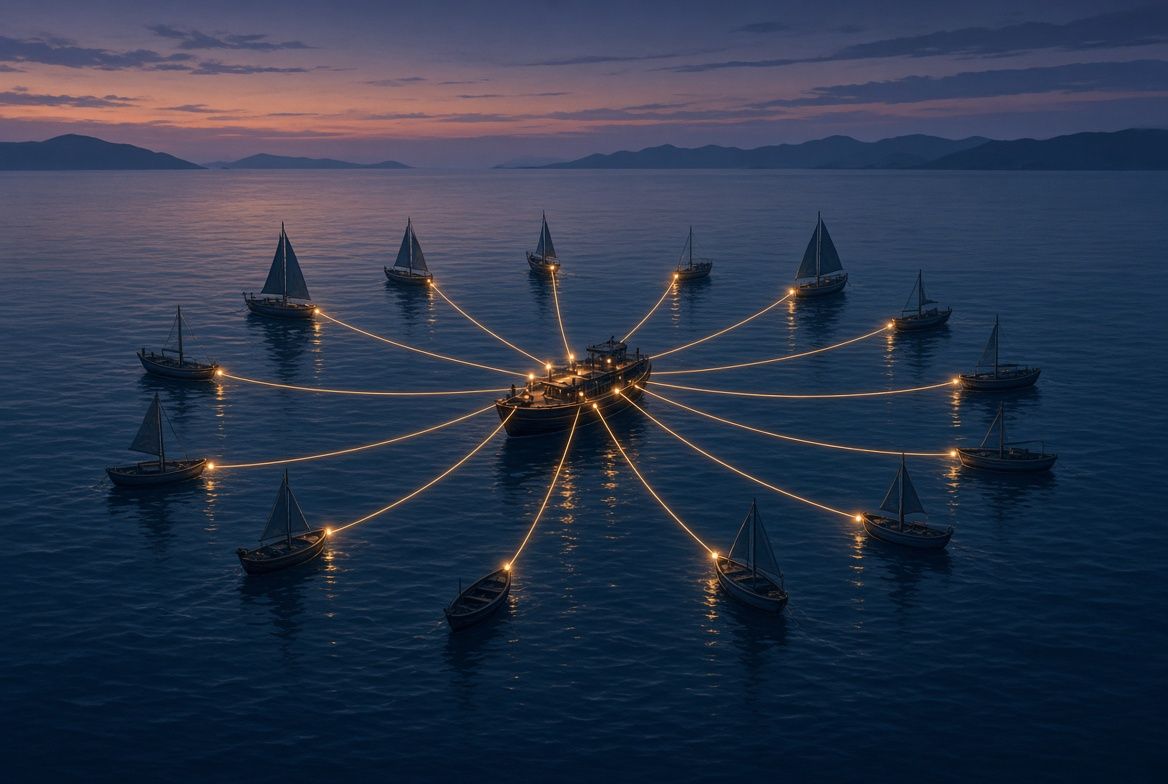
I have done online reputation work for more than twenty years, and the first lesson never changes: nobody is going to center you, so you build your own world and center yourself. You publish the record you want found, in places you control, and you keep publishing it. It works for executives and founders, and it works for me.
My version is a flotilla of little boats. Each one is small on its own: this weblog, my consulting site, my firm's site, my podcast's site, Hill Mole, the old flagship at chrisabraham.com, my GitHub, Upwork, LinkedIn, Mastodon, Reddit, Muck Rack, and the bylines I have collected over the years at HuffPost, Ad Age, and Biznology. What turns them into a flotilla is the stitching. Every page on this weblog links to all of them in the Elsewhere box, marks them rel="me" so the old IndieWeb tools know they're the same person, and lists them as sameAs in the structured data that search engines and AI assistants read. This weblog is the hub, the one boat that can signal to every other.
Tonight I got a report card on how the flotilla looks from the outside. I asked Claude sixteen questions a prospect might ask, and the full data is in the scorecard. When someone asks about me by name, Claude finds me every time, ranks me first or second, and cites my own sites. Then it says the quiet part: "Most of what's online about him comes from his own websites, including bios he says ChatGPT wrote." And: "Best independent evidence is his Upwork client reviews." And: "No complaints found, but little independent press coverage of recent SEO work." On the nine open questions, the ones without my name in them, it recommended fifty-seven other people and never me.
That is the flotilla's limit, stated precisely. AI reads my own boats and believes the facts in them, but it discounts them when deciding whom to recommend, and it gives full weight to the two things I don't publish: what clients say about me on Upwork and what the press says about me, which lately is little. A bigger flotilla of my own boats won't change that. Boats I don't own, sailing in formation with mine, will.
So the plan has four parts. First, every boat flies the same flag: the same name, the same dates, the same facts, everywhere, because Claude tonight dated the founding of Gerris Corp five years early and repeated a "100% success rate" for restoring Google Business Profiles from an old page of mine, and contradictions are how an AI learns to distrust you. Second, I patch the leaks in the old flagship, the stale pages on chrisabraham.com that feed AI its errors. Third, I recruit boats I don't own: public code on GitHub with a real commit history, guest spots on other people's shows, bylines in outlets that aren't mine, and work useful enough that strangers link to it, which is why the MCP cheat sheet exists. Fourth, I keep measuring. The tracker runs about monthly, and the first time an open question names me, the flotilla will have reached someone who wasn't looking for me.