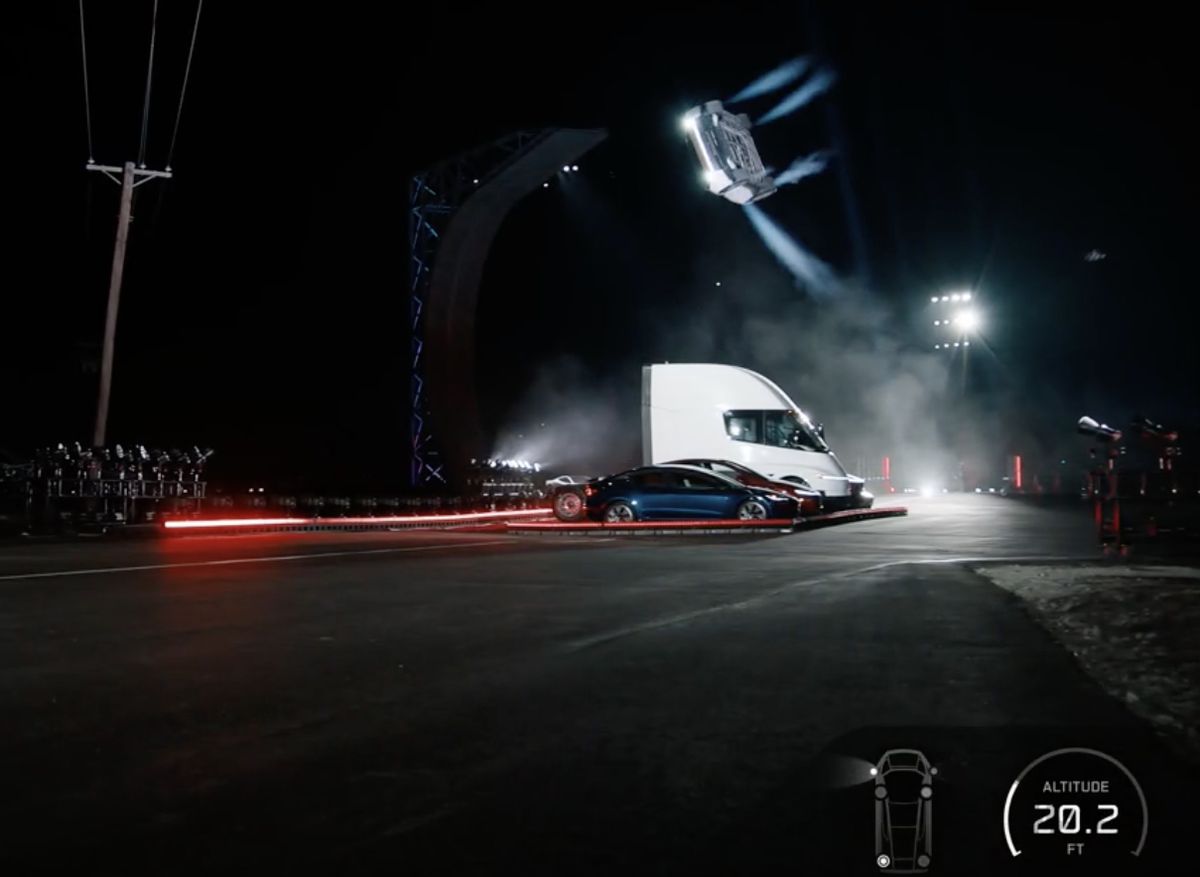
On October 15, 2026, at SpaceX's rocket test site in McGregor, Texas, outside Waco, Tesla finally showed the second-generation Roadster, nearly nine years after it rolled out of a Semi trailer to the Beastie Boys' "Sabotage" on November 16, 2017. The reveal had already slipped from April 1 and from an October 1 date that rain washed out. What came out of the dark this time was a car that drove up an inverted ramp, spun, landed, and then hopped over a Cybercab, a Cybertruck, a Semi, a Model Y, and a Model 3, according to TechCrunch. Nobody was in it, as Electrek points out. Elon Musk called it "the best of the last of the human-driven cars," and he also said "safety is not the main goal" and that Tesla would "aspire not to kill anyone in this car."

I like this car for the engineering, so this post is the engineering. Every number below is Tesla's claim as reported by the outlets linked, unless I say it's my own arithmetic.
Three trims, three ways to cheat traction
Every fast car hits the same wall: you can only accelerate as hard as the tires can push on the road, which for street tires is somewhere around 1 to 1.5 g. Tesla's answer is three trims that each add a way around that wall.
| Trim | Seats | What it adds | Claimed 0–60 mph | Top speed | Reservation |
|---|---|---|---|---|---|
| Performance ("road ready") | 2 | Active aero and four suction fans | under 1.6 s | about 210 mph | $50,000 |
| Thrust ("race ready") | 2 | Four rear cold-gas thrusters, 200 L of air | under 0.9 s | 230 mph | $250,000 |
| Rocket ("air ready") | 1 | Ten thrusters and 400 L more air, for flight | under 0.59 s | over 230 mph | Invite only; off-road use only |
Trims, seats, and reservations from TechCrunch and Wikipedia's sourced summary; top speeds and tank sizes from Electrek. No price was announced, and Musk says production starts in 2028. One correction to the AI summaries floating around: the "$5,000 now, the rest within ten days" deposit terms they repeat come from the 2017 reservations, and I couldn't find them stated for 2026.
The thrusters: SpaceX's cold gas, at sea level
A cold-gas thruster is the simplest rocket there is: a tank of gas at enormous pressure and a nozzle. Nothing burns. Tesla's version stores air at 10,000 psi, about 690 bar, in carbon-fiber overwrapped pressure vessels, the COPVs SpaceX flies on Falcon 9. Reports differ on the gas: Electrek says compressed air, and MotorTrend's explainer says mostly nitrogen. The Thrust trim carries 200 liters behind the seats and fires four rear ports that together make about 80 kilonewtons. The Rocket adds 400 liters, which is why it gives up the passenger seat, plus a downward thruster at each corner and two up front for yaw, ten in all. The car can top up its own tanks with an onboard compressor, but Electrek reports a full refill takes six to seven hours today, against Tesla's hope of thirty minutes. Musk first promised a SpaceX option package with small thrusters in 2018, and later described the tank taking the place of the rear seats.
- Four rear ports, about 80 kN together, on the Thrust and the Rocket.
- Rocket only: a downward thruster at each corner, plus two front thrusters for yaw, ten in all.
- Compressed air at 10,000 psi in carbon-fiber tanks: 200 liters on the Thrust; the Rocket adds 400 liters and gives up the passenger seat.
- The dashed squares are four suction fans, about 20 kW each, on every trim.
The rocket math
Here is where it gets fun. The car weighs a claimed 1,700 kg, so its weight is about 16,700 newtons. Eighty kilonewtons of thrust is nearly five times that, a thrust-to-weight ratio fighter jets would envy. Now check it against the claims: going from 0 to 60 mph, which is 26.8 meters per second, in 0.55 seconds means averaging about 49 m/s², or 5 g. In 0.81 seconds, the live-demo time, it's 3.4 g. Tires alone can't do either, so the thrusters have to carry most of the launch.
And they can't carry it for long. This part is my own back-of-envelope estimate, not a Tesla number. Cold air at sea level has a specific impulse of roughly 60 seconds, a measure of how much push you get per kilogram of gas. At 80 kN that burns about 136 kilograms of air every second. Air at 690 bar weighs roughly 0.4 kilograms per liter, so the Thrust's 200 liters hold about 80 kg and run dry in a little over half a second at full blast, about the length of a launch. The Rocket's 600 liters, about 250 kg, last around two seconds. Electrek reached the same conclusion from the video: a few seconds at full power at most. These are flight-and-launch systems measured in heartbeats.
The fans: borrowing from the fan cars
Every trim has four suction fans under the floor, about 20 kW each, roughly 80 kW or 108 horsepower in all, with skirts that seal the underbody and lift away at high speed. The fans pull air out from under the car so the atmosphere presses it into the road, at a standstill as well as at speed. Tesla's on-screen display claimed about 4,700 kg of downforce, which Electrek calls "potentially unreal." The benchmark is the McMurtry Spéirling, a 900 kg single-seat fan car that makes 2,000 kg of downforce standing still and in April 2025 set an outright Top Gear test track record of 55.9 seconds, 3.1 seconds quicker than a 2004 Formula 1 car. Downforce is also what let the Roadster climb that inverted ramp: enough suction, and the road can be above you.
The rest of the spec sheet
| Item | Claim |
|---|---|
| Power | over 1,341 hp (1,000 kW) from Performance up; "over 1 MW" in top spec |
| Drive | Rear-wheel drive, two rear motors (the 2017 concept had three), steer-by-wire |
| Weight | under 1,700 kg (about 3,700 lb) |
| Battery | 4680 cells in the floor; capacity not disclosed |
| Range | over 300 miles (the 2017 promise was about 620) |
| Charging | over 500 kW on Supercharger V4; 15 to 80 percent in about 10 minutes on an 800 to 1,000 volt pack |
| Track endurance | 25 to 30 minutes at maximum power |
| Wheelbase | 111.2 inches |
| 0–60 times shown | 1.0 s on a recorded test; 0.81 s live, not independently timed; 0.55 s claimed for the top spec, including a one-foot rollout |
From Electrek and Wikipedia. That "one-foot rollout" is a drag-racing convention: the clock starts after the car has already moved a foot, which shaves time off every 0–60 figure that uses it.
The zeitgeist
The Roadster lands in a strange moment. Tesla's own future is the Cybercab, a car with no steering wheel, and here is Musk selling the last great car you drive yourself, built with parts from his rocket company while investors speculate about a Tesla and SpaceX merger. He said himself that he's "not sure it moves the needle massively from a revenue standpoint." Electrek calls the jumps and flips "just a party trick" with no performance benefit, notes that a thruster plume throws debris tens of meters, and doubts the flying version will ever be practical. The 2017 reservation holders have been waiting almost nine years. And the first Roadster, the one Musk launched on a Falcon Heavy in February 2018 with a mannequin named Starman at the wheel, is still out there circling the Sun, which makes it the only Tesla Roadster so far to have actually flown farther than twenty feet.
About the pictures
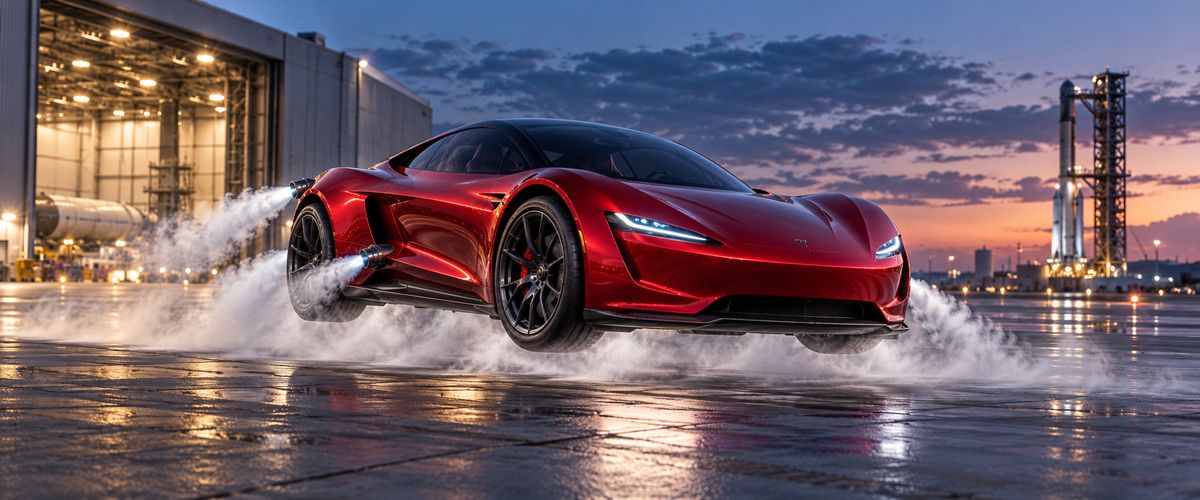
The video is Tesla's own upload, played through YouTube's player only when you press play. The photograph at the top is Tesla's too: a frame from its own livestream, credited to Tesla by TechCrunch, which ran it the same night. I use it here to report on the event it shows, with credit, at reduced size, and I host the copy myself instead of pulling it from anyone's server. The diagram is mine, and the red illustration is an AI image I made with ChatGPT, labeled as such where it appears. Many outlets published striking photographs of the reveal, including Top Gear, Euronews, Ynet, Inc., and Mashable. Those belong to their photographers and publishers, so I link to them instead of copying them. Labeling someone else's photograph "fair use" doesn't make it so, and I'd rather send you to the people who shot them. If you own an image here and want it credited differently or removed, write to me.