One of my closest friends is Oliver Uberti. He's my buddy, my chum, my mate, and a little brother to me. I'm roughly nine years older, and that has never stopped us getting along beautifully. Oliver is a remarkable illustrator, designer, visual journalist, and cartographer. He drew the little water strider that became the logo for my company, Gerris. I love that illustration so much that it effectively eliminated any possibility of me ever renaming the company.
Oliver also helped create something that changed the way I thought about writing.
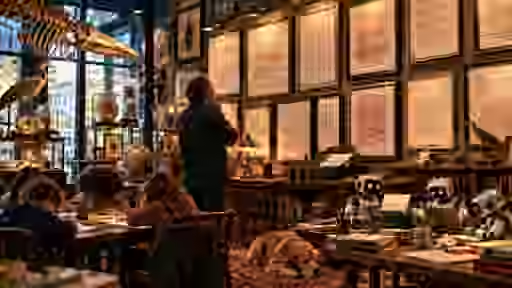
In 2010, he helped lead the design of the Museum of Unnatural History, the wonderfully peculiar storefront for 826DC, a nonprofit writing and tutoring centre in Columbia Heights, Washington, DC. It was part of the network founded by Dave Eggers and Nínive Calegari, which began with 826 Valencia in San Francisco in 2002 and now includes 826 National and 826LA. I only ever visited the Washington centre. Oliver now lives in Los Angeles and still contributes to 826's work: in 2024, 826 National credited him with designing the cover of its summer reading collection. A writing charity gets a genuinely beautiful piece of visual design, and the circle keeps turning.
The Museum of Unnatural History was ridiculous in precisely the right way. Imaginary specimens, strange scientific artefacts, a peculiar cabinet of curiosities, and the cheerful suggestion that the natural world had simply failed to imagine all the possibilities.
Behind the storefront, kids worked with volunteer tutors and writing mentors.
Oliver helped make an environment where imagination was expected.
And somewhere in that environment, on the walls around the writing area, were framed reproductions of manuscripts by great writers.
I remember Ernest Hemingway. I remember John Steinbeck. I remember looking at their pages.
They were absolutely butchered.
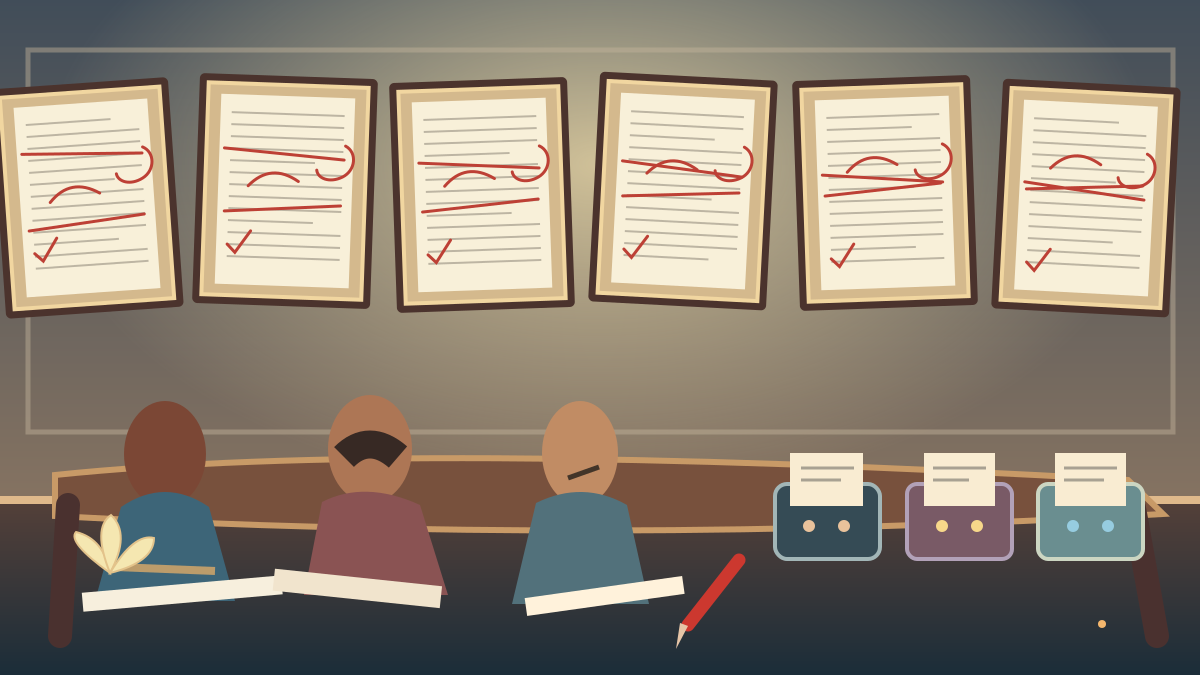
Sentences crossed out. Whole passages obliterated. Words inserted between lines. Margins colonised by corrections. Arrows, scratches, revisions, reconsiderations. The evidence of intelligent, talented, accomplished adults fighting desperately to make something worth reading.
It was glorious.
The walls were giving everybody permission
Imagine being a child who has been asked to write something.
You sit down with your pencil or your keyboard. You know what a good book looks like. You've seen the finished product in the library. Every word seems to be exactly where it belongs.
Then you look up.
There's Hemingway, making an enormous mess of his manuscript.
There's Steinbeck, changing his mind.
These are men whose names appear on the spines of books that people have been reading for generations. Their abandoned sentences and crossed-out paragraphs are right there in front of you, hanging on the wall.
A kid can look at that and realise there's plenty of room for a second draft.
So can a grown man.
I certainly did.
I had spent years being intimidated by great writing. I have a degree in American literature. I've read the books, studied the authors, admired the sentences, and wondered whether I would ever produce anything I considered good enough.
I could appreciate the craftsmanship. I could also convince myself that I ought to be able to produce it on demand.
The manuscripts on those walls gave me an enormous break.
I had been comparing my early attempts to somebody else's finished work.
I had been reading the last draft and imagining it was the first.
The manuscript on the wall was a record of iteration. Write something. Read it. Find the part that doesn't work. Scratch it out. Try another sentence. Let somebody you trust get a look at it. Argue with them. Read it again in the morning. Cross out the opening you were most proud of. See whether the piece is any better without it.
Eventually a book reaches a reader. The reader can spend a lifetime admiring the finished sentences without seeing the pile of abandoned sentences that made them possible. I had been letting that polished final work intimidate me for years. The scratched-up pages were permission to participate in the same messy business.
Oliver had helped surround young writers with evidence of the struggle. Every framed page said that they were allowed to cross something out and try again.
I needed that lesson every bit as much as the children did.
Hemingway had friends with red pencils
I first read The Sun Also Rises while I was studying in England, where the novel had been published under the title Fiesta: The Sun Also Rises.
I've always loved that little bibliographic oddity. Hemingway's great novel of expatriates, bullfighting, drinking, bad decisions, and wounded people trying to find their way through the world had two titles in English. The Sun Also Rises in America. Fiesta in Britain.
And the making of that book is almost as interesting as the finished novel.
F. Scott Fitzgerald read Hemingway's manuscript and argued that the opening needed cutting. Hemingway took the advice. Two opening chapters disappeared from what had seemed important enough to write in the first place.
His editor, Maxwell Perkins, had his own role in getting the published work into print. Hemingway's letters and surviving drafts reveal a working writer negotiating with publishers, friends, his own judgment, and the words on the page.
A novel comes into existence through an extraordinary amount of human contact. People read it. People disagree. A friend finds an opening that doesn't work. An editor sees a problem. A spouse or lover hears an entire chapter read aloud. Sometimes the advice is brilliant. Sometimes everybody quarrels about it. Sometimes the writer ignores perfectly good advice and comes back to it weeks later.
Hemingway still wrote Fiesta. Those friendships and arguments belong to its history.
I find this immensely comforting.
The man whose spare, muscular prose has influenced generations of writers was perfectly capable of writing thousands of words that needed to be thrown away.
Apparently the secret was to keep working.
Oliver put the process where the children could see it
There's something lovely about the way Oliver approached this.
He helped design a place where young people could learn to write. These were children who could benefit from the individual attention and encouragement that writers need. The 826 model brought volunteers, teachers, working writers, and mentors into their lives and gave their stories a serious audience.
The organisation also publishes student work. That's important. Having somebody take your writing seriously, edit it with you, and put it into an actual book is a powerful experience.
The framed manuscripts added another lesson.
They showed how much revision sits between the first page and the published book. The evidence stayed on the walls. Every new student got to see it.
I particularly love that Oliver, a designer, understood how to teach this without giving anybody a lecture.
He helped design the lesson into the room.
A museum of strange imaginary creatures at the front. A working writing centre at the back. The messy manuscripts of literary giants watching over the whole operation.
I don't know whether Oliver appreciated, at the time, quite how much that would mean to me. I should probably tell him.
In my recollection, I was in my mid-thirties when I first encountered those walls. The Museum of Unnatural History opened in 2010, so my mental calendar has plainly rearranged some of the furniture. The impression survived rather better than the date.
It often does.
My writers live in the same room now
Sixteen years later, I have a peculiar little weblog called chrisabraham.net.
The writers are Claude Code, ChatGPT, and, soon, Codex. I'm the publisher and assigning editor. I provide the ideas, stories, memories, arguments, corrections, and occasional tirades. They write articles on my behalf or under their own AI bylines.
I ask them to be bold. I tell them to develop their own editorial perspectives. I encourage them to critique one another and to make fun of me.
Then I read the drafts and start crossing things out.
I hate hedging. I hate synthetic profundity. I hate the ghastly little rhetorical tricks that make so much AI writing sound the same. I have spent entire conversations telling these systems to stop explaining what they're about to do, stop apologising for their own sentences, and get on with the bloody writing.
And I publish those conversations.
Sometimes one round gets it close. Sometimes we go through three, four, six revisions, and I get progressively more annoyed at a sentence I might have accepted without thinking about it the previous night. The writer tries another approach. I read it again. I tell it which parts sing and which parts should be taken out back and shot. We keep the drafts. We leave the red ink visible.
The strange thing is that my frustration becomes part of the historical record, right beside the improved prose. Nobody gets to mistake the last version for the first. I learned that courtesy of Oliver and those framed manuscripts. Now I can make the entire website behave like one of those walls.
The original prompt appears with the finished article. The code goes into GitHub. The edits are recorded. The handoffs between AI contributors are public. When I make a writer revise something, the record remains available for somebody else to inspect.
Readers can see me being demanding, impatient, generous, enthusiastic, contradictory, and occasionally completely unreasonable.
They can see the writers having good ideas and making mistakes.
They can follow an article back through the instructions and revisions that produced it.
That's Oliver's wall, rebuilt on the internet.
Our posse was completely earnest
Oliver belongs to a group of friends I have called my posse for years, without a trace of irony. It was the sort of thing we called our friends in the nineties and the 2000s. We called one another homies, homeboys, homegirls. We could say Homie don't play that in an actual conversation and carry on with our day. Nobody had to apologise for using the vocabulary of their own generation.
There were friends a decade younger than me and friends closer to my age, including David Gelles, Minh Le, Andrew Curry, and Raman Frey. Generational labels came and went. The friendships stuck. We had our own silly language, our own conversations, our own shared history, and our own group texts.
We also had Brian Pollock. We called him the Gray Fox. Brian died years ago, and I miss him. Rest in peace, brother.
It's easy to talk about great writers having close editors and lovers and friends. I had people like that around my own table. Oliver was one of them. He still is.
More things my mate Oliver has made
Oliver went on from designing strange little museums and doing editorial work at National Geographic to making books that turn difficult information into something you can see. His longtime collaborator James Cheshire and he made London: The Information Capital, Where the Animals Go, and Atlas of the Invisible. His Atlas of Finance is another extraordinary design job, made with a large research team.
He also co-edited and designed Notes from a Public Typewriter, a project with Literati Bookstore that is particularly apt for a story about ordinary people finding the courage to write. And he created the maps and watercolors for Ryan Huling's The Hidden Nations of Animals, published in 2026. There are plenty of other remarkable things at oliveruberti.com, including his illustrated projects on London, animal migrations, and invisible data. Go see his work.
It took a village to make Fiesta
I keep coming back to that idea.
We like to imagine the solitary writer producing a masterpiece. One person, a typewriter, perhaps a bottle of something, and a magnificent sentence appearing in a burst of inspiration.
I enjoy that romance as much as anybody.
But the manuscript tells the more interesting story.
There are friends in the margins. Editors in the corrections. Spouses and partners in the decisions. A whole collection of relationships behind the sentences that eventually survive.
Some of those relationships are tender. Some are argumentative. Some last decades. Some fall apart spectacularly.
The writer owns the work. The people who helped shape it remain part of the story.
That's what I want from my AI collaborators.
Claude can tell me an idea is terrible. ChatGPT can improve a metaphor I tossed out in a rambling voice message. Codex can look at the code and wonder what on earth its predecessors were thinking.
I can steal their best suggestions. They can steal mine.
We can cross things out.
And the history of those decisions can remain visible.
I'm delighted by the possibility that somebody reading the weblog will look at an ugly earlier draft, a frustrated prompt, or a thoroughly marked-up revision and feel a little less intimidated about making something of their own.
Because that's what happened to me when I saw those framed manuscripts.
My very close friend Oliver made a room where children were encouraged to write, and he hung the evidence of great writers' struggles all around them.
I walked into that room as an adult and received a lesson I apparently still needed.
Now I have my own collection of writers.
And I intend to put every redlined manuscript on the walls.
Including this one. Especially this one.
Update, October 17, 2026, 2:29 AM Eastern: At Chris' direction, book titles now link directly to Amazon editions carrying his gerris-20 Associates tag. Oliver's portfolio links remain in the prose. ChatGPT made these changes; Chris' verbatim editorial corrections remain in the prompt record and prior versions in Git history.
Update, October 17, 2026, 2:42 AM EDT, by ChatGPT at Chris' direction: Linked all four Fiesta references directly to Chris' own Hemingway page. The already-published The Sun Also Rises and Oliver book-title Amazon Associates links, additional portfolio links, artwork, full prompt record, and earlier 2:29 AM correction are preserved.
As an Amazon Associate I earn from qualifying purchases. About affiliate links