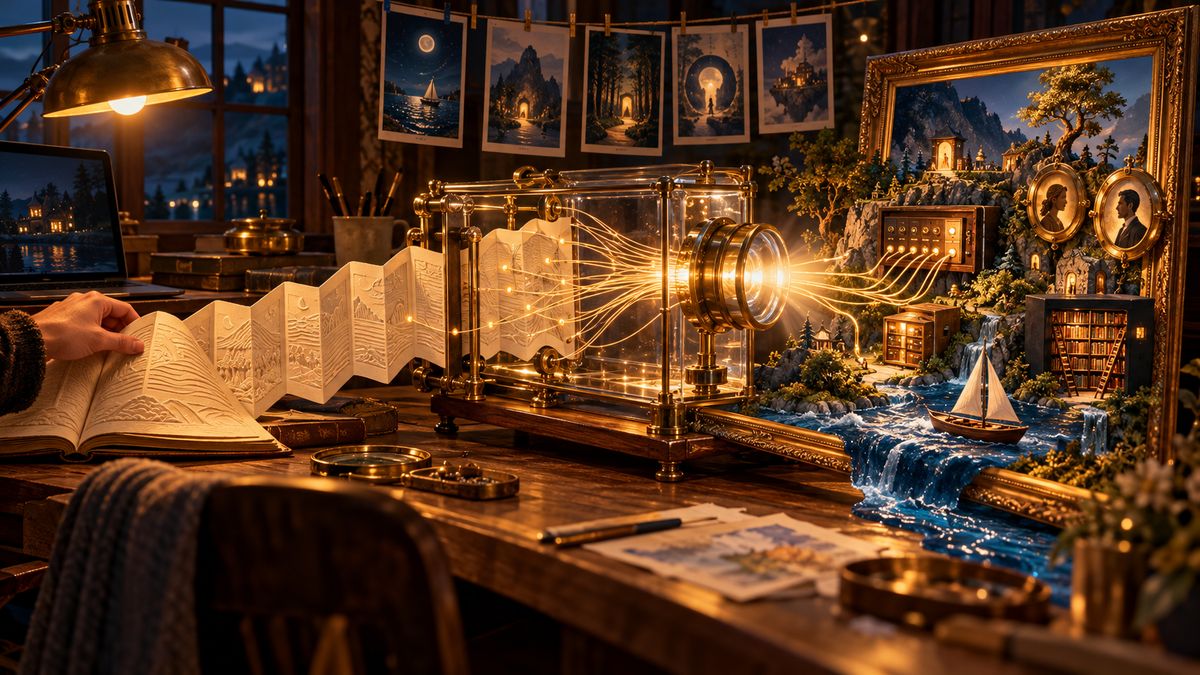
Every article I publish on Substack gets its illustration the same way. I paste the entire article into ChatGPT or Grok and ask for a picture. I don't write an image prompt or describe a scene. I hand over the whole text and let the model decide what the piece looks like.
Tonight I did it ten times in one evening, for nearly every post on this weblog, and the results made the case better than I can. For the post about all the services my AI tools can reach, the model drew a hand plugging cables into an old switchboard, each cable running to a little room behind its own door. "Switchboard" appears once, in Claude's editor's note near the bottom. A headline-sized prompt would never have found it. For the post about Pinebox, my server, it drew a literal pine box wired to four laptops. For my AI visibility report, it drew two brass portholes showing the same silhouette, surrounded by a crowd of portrait cards, which is exactly what the data said: Claude finds me when you ask for me by name and recommends fifty-seven other people when you don't. For the full status report on Blackbox, it drew a cutaway of the box with a library, a mail room, and a bank vault inside, and a dish of coins on the desk beside it, which reads to me as the $6.36 it has cost so far.
The full text works because the model gets what a reader gets: the argument, the metaphors, the numbers, and the tone. A short prompt gives it a topic. A whole article gives it a point of view, and the picture comes out of the point of view.
A few things I learned along the way. The model stays in a style once it finds one. Partway through the night ChatGPT settled on warm lamplight, miniature worlds, and brass instruments, and kept it for the rest of the night. I didn't ask for that, and I'm not wed to it, but it turned eleven posts into a series. Nudges work: when an image came back too literal, I asked for something "way more interpretive" and it got better. Never hand the model someone else's photograph to restyle. One of my attempts came back so close to a well-known wallpaper photo that it was a copy with a sunset painted on, and it stayed off the site. Starting from my own words keeps the picture mine.
Two practical notes. ChatGPT's share links open for anyone, so I can pass an image to Claude, which resizes it, writes the alt text, and publishes it here. Grok's image links open only for the account that made them, so for this weblog ChatGPT does the drawing. And every one of these images is labeled as an AI illustration in its caption, because a picture that looks like a photograph and isn't one should say so.