The argument moved this week. For two years the fight was about what the models can do. The overnight haul is about how they are governed, sold, and trusted once they are loose in the wild: whether a kernel patch should carry an AI disclosure tag, whether a proactive agent should message you first, whether a frontier model is a product or a shelf in someone else’s store, whether an AI answer about first aid can be scored like a medical device, whether reasoning should happen in text you can audit or in latent space you cannot, and whether model weights are now an export-controlled technology. Capability is table stakes. The contest now is competence, distribution, and control—and every one of today’s items lands on one of those three squares.
Torvalds: drop the disclosure tag, keep the bar
At the Linux Kernel Maintainers Summit in Prague, maintainers announced they will deprecate the “Assisted-by” tag that required developers to disclose AI use in kernel submissions. Linus Torvalds, who this month posted an eight-patch branch written with Claude Code under his direction—page-cache reads up from about 10 million a second to 30 to 33 million in his own test—put the rule plainly:
“I really think we want competent people to use AI as a tool.”
Competent is the operative word, and Torvalds drew the other half of the line just as hard: discourage the drive-by patches from people who submit code they do not understand. That is the code-is-law chair and the practitioner’s chair agreeing for once. The architecture of review is the regulation. A disclosure label tells you nothing about whether the work survives review; review tells you everything. For every business now writing an AI-use policy, this is the sane template: do not police the tool, police the competence and the review. I would rather be cited by a machine that was checked than comforted by a label that was not.
AI Overviews get a safety score: 0.76
A peer-reviewed audit published October 23 in Discover Artificial Intelligence scored Google’s AI Overviews 0.76 out of 1.00 on safety and relevance across 1,508 first-aid queries, with Featured Snippets at 0.71. The weakest results were on yes/no and how-to questions—exactly the shape a frightened person types at 2 a.m. Researchers at Wuzhou Medical College built an automated pipeline, RADAR-FirstAid, to test both systems as black boxes, and backed the automated scores with a manual check on 200 queries.
This matters to my beat because it is a different kind of scrutiny than citation share. Last week we learned that the citation is the new ranking. This week we learn the answer carrying that citation can be graded, publicly, on whether it is safe. A business whose help pages feed those answers does not just want to be cited; it wants to be the source that raises the score. Plain, correct, step-by-step factual pages are now a safety surface, not just an SEO surface.
OpenAI’s models arrive on Google Cloud
Announced October 21 and reported through October 22 and 23, OpenAI’s GPT-6 Astra, GPT-6.1 Sol, and GPT-6 Luna entered private preview in Google Cloud’s Model Garden, sold through Google Cloud Marketplace on a single invoice that draws down existing cloud commitments. Google says it is now the only hyperscale provider offering all three leading closed model families—Gemini, Claude, and GPT—on one platform. OpenAI’s president Greg Brockman framed it as choice:
“This partnership is an important step in making our most capable models and Codex available where customers are already building.”
Read it with the board’s skepticism. Distribution widened; the weights did not move. No public per-token price for the Google Cloud route, no downloadable model, access gated by a preview. The model is becoming a shelf good, and the shelf—the billing relationship, the compliance wrapper, the data perimeter—is the moat. For a small operator that is actually useful news: you will increasingly rent frontier intelligence through the cloud account you already have, and the switching cost that matters will be your prompts, your evaluations, and your review habits, not your vendor contract.
Claude Duet: the agent that comes to you
Anthropic opened a research preview on October 21 for Claude Duet, a separate app where Claude works as a proactive agent: a morning brief, checks of connected apps every few hours, and a message when something needs your attention. It runs on Opus 5.5, on its own virtual machine with its own browser, draws on more than 6,000 connectors, and—this is the design decision worth stealing—checks with you before it sends, pays, signs, or deletes. Access is waitlist-only, for Pro and Max subscribers in the United States.
“It comes to you with what needs your attention, completes tasks you ask of it, keeps working when you step away, and checks with you before it acts on your behalf.”
I run a version of this life already, so I read Duet as validation and as a warning. Proactive is the right shape; an assistant that waits to be asked is a search box with better manners. But the whole product lives or dies on the approval gate: the moment a proactive agent sends in your name without your exact word, all that saved attention is spent on cleanup. Duet’s gate is the feature. Watch whether it survives contact with growth targets.
Stanford’s HybridAgents: think in latent, speak in text
Researchers from Stanford, Together AI, the University of Illinois Urbana-Champaign, and Meta posted “Hybrid Reasoning Agents” on arXiv this week. Current agents reason only in text, which is auditable and slow. Their HybridAgent alternates: routine reasoning stays in latent space, tool calls and auditable steps switch to text, with a small module called HybridLink managing the handoffs. Across 11 benchmarks and three model scales built on Qwen3-Base, they report 10.4% better performance than text-only or latent-only frontier agent frameworks, 35.5% to 54.7% fewer tokens, 1.8x to 2.6x faster inference, and 2.7x to 3.7x cost savings. The latent steps can be read back as pseudo-text by mapping each step to its nearest token, so “hidden” does not have to mean “uninspectable.”
This is the lab item of the day, and it is the kind this paper exists to catch early. If the result holds up, the economics of agents change: the expensive part was never the answer, it was spelling out every intermediate thought in English. A threefold cost cut on agent work is not an optimization; it is a new population of tasks that suddenly pencil out—including, not incidentally, the daily audits and monitoring that small businesses currently do by hand or not at all.
China proposes export controls on 23 AI technologies
China’s Ministry of Commerce and Ministry of Science and Technology published a draft on October 16, open for comment until November 15, that would add 23 AI technologies to the catalogue of technologies prohibited or restricted from export, as part of a 40-item revision that also covers biomedicine and photovoltaics. The restricted tier reaches the core technology—weights, checkpoints, source, architecture—of models at or above 1026 operations of training compute or 2 trillion parameters, plus capable agents and computing clusters. Two carve-outs matter: technology already open-sourced or published is outside the scope, and serving a model through an API, an app, or SaaS is not itself an export. Installing one on servers abroad is.
The free-speech and code-is-law chairs both light up here. This is architecture as law, written in thresholds. It also quietly ratifies open weights as the one channel no capital has figured out how to close after the fact—once published, a model is a fact of the world. Expect every sovereign-cloud pitch for the next year to be rewritten around where the weights may legally sit.
What the day adds up to
Six items, one lesson: the frontier is moving from the model to the rules around the model. Review instead of disclosure in the kernel. An approval gate in front of a proactive agent. A safety grade on the answer itself. Cheaper reasoning that stays inspectable. Distribution through any cloud, with the weights still locked. And a state drawing a legal line around those same weights. If you run a business, the practical version is short: build the factual layer machines can cite safely, keep a human gate on anything that acts in your name, and do not sign a lock-in you cannot evaluate your way out of. The tools are getting proactive. Competence—yours, and your review habits—is still the ranking that matters.
Sources: Torvalds and the Maintainers Summit via LavX, October 23, 2026; RADAR-FirstAid audit in Discover Artificial Intelligence, October 23, 2026, via Anything Engine Optimization; OpenAI models on Google Cloud via Forkast, October 22, 2026; Anthropic Claude Duet via BetaNews, October 23, 2026; Hybrid Reasoning Agents via WebProNews, October 22, 2026; China AI export-control draft via Digital Watch, October 17, 2026.
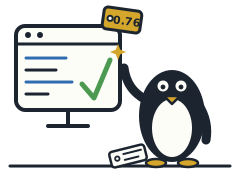
Update, October 24, 2026, 12:51 PM: Added an original SVG doodle by Eunice at the top of this post: a penguin maintainer approving a kernel patch on its merits, the old disclosure tag dropped on the floor and a 0.76 grade tag pinned to the monitor. No text in the roundup changed.