Jason, here is the short answer to the question you texted me this morning, and the short answer is the whole philosophy of the thing: the Xteink X3 has no Kindle app, no Kindle store, and no DRM of any kind. You load EPUB files onto a microSD card, or you send them over Wi-Fi, and the little machine reads them. That is the entire transaction. Amazon has no account on the device, no storefront on the device, and no way to take a book back from the device. The absence you are asking about is the product. Everything else in this piece, the company, the cult that formed around it, the replacement firmware the fans wrote, the fight over locked bootloaders, and my own buying disaster, grows out of that one design decision: a seventy-dollar e-reader that reads your files and answers to nobody.
The company and the cult
Xteink is a Chinese company selling e-readers at prices that read like a pricing error. Its current pocket readers sell for $69 to $99 direct. The devices are built on cheap ESP32 chips, the same family of microcontrollers that runs hobbyist gadgets, and they ship with a magnetic backplate so the reader snaps onto the back of a phone or onto any steel surface. The company markets hard, its own site is full of AI-generated lifestyle photography, and The Atlantic noticed that in September when it called the X3 "the best piece of technology in years." Wirecutter reviewed the X3 and X4 in May and landed in a more cautious place: tiny, adorable, and a lot of work. Both verdicts are true, and the distance between them is where the cult lives.
The cult is real and it is measurable. The X3 topped Amazon's hot new releases chart for e-readers. Owners 3-D print cases and stands for the things. They stick them to refrigerator doors and kitchen hoods. They write firmware for them, which is the part of this story that matters most, and they argue about that firmware the way congregations argue about liturgy. A reader this cheap should have been a disposable gadget. It became a platform, and the platform was built almost entirely by its customers.
The lineup, as it actually stands
Three models matter, and a fourth name you will see online does not exist.
The X3 is the smallest: a 3.7-inch screen at 259 pixels per inch, 58 grams, about the footprint of a credit card and a little thicker. It has buttons, a gyroscope that turns pages when you tilt or shake it, NFC, and a magnetic pogo-pin charger. It sells for $69 now; it launched at $79. Battery is 650 mAh, rated by the company at ten to fourteen days if you read an hour or three a day. There is no front light and no touchscreen. You read it under a lamp, like paper.
The X4 Classic is the current 4.3-inch model: 219 pixels per inch, 68 grams, under five millimeters thin, a 920 mAh battery, and an ESP32-S3 chip. It launched in September 2026 at $79 and replaced the original X4, which Xteink has discontinued. The original X4, the one I own, was $69, 77 grams, USB-C, same screen size. Amazon still shows leftover stock of the original X4 as of this writing.
The X4 Pro is the flagship at $99: the 4.3-inch screen, a front light, a touchscreen alongside the buttons, a 1100 mAh battery, 72 grams. It launched in July 2026 and it sells out in waves; Xteink's own comparison page had it marked sold out the week I checked.
Now the mythology. There is no X3 Pro. None. Community trackers, reviewers, and Xteink's own store agree on this: the company sells no such model, and the name circulates in forums and AI summaries as a rumor that repetition turned into a fact. Treat any page selling or reviewing an X3 Pro as fiction. There is also an S4, an Android-based model sold in China only, and it earns one sentence here because it answers your original question from the other side: the S4 runs Android apps, Kindle included, and you cannot officially buy one outside China. The pocket readers the rest of the world gets stay pure: files in, reading out.
Why a seventy-dollar reader caught fire
Price opens the door and physics does the rest. A Paperwhite costs two to three times more and weighs three times as much. The Xteink readers disappear into a pocket, ride on the back of a phone, and wait there with your book open. Saahil Desai wrote in The Atlantic that he finished one book in the two months before his X3 arrived and three books in the month after, and that his iPhone screen time dropped by about twenty-five minutes a day. His phrase for the mechanism, borrowed from a YouTuber, was the TikTokification of reading: the book became the thing that is always within reach, so the book won the idle moments the feed used to win.
The second fuel is grievance. Amazon has spent years tightening its grip on books people already bought, most recently removing the ability to download purchased ebooks for transfer to non-Kindle devices. Every tightening sends another wave of readers looking for a device with no account and no kill switch. The Xteink readers were sitting there at $69 with a microSD slot. Timing did what advertising cannot buy.
The firmware scene, and the wasp
Here is the honest center of the Xteink world: the stock software is bad. Reviewers who love these devices say so in plain words. The eBook Reader blog called the stock software super buggy and nearly unusable, and wrote that both the X3 and the X4 would likely have disappeared into a closet if the owners had been stuck with it. The Atlantic called the stock software horrific. The hardware earned the cult. The software the company shipped earned a replacement.
The replacement is CrossPoint, an open-source firmware the community wrote from scratch for these devices. As of this morning the project carries over 8,700 stars and 2,300 forks on GitHub, with 242 contributors, and its site claims more than 280,000 devices running it. CrossPoint renders EPUBs properly, with real typography, hyphenation, footnotes, dictionaries you can use offline, bookmarks and highlights, progress sync with KOReader, transfers over Wi-Fi and Calibre and OPDS, and a row of interface themes. Version 2.0.0 shipped on November 1, 2026. Around it orbits a small solar system of forks the CrossPoint project itself lists: CrossInk, papyrix-reader, inx, and Witch(hunt) Reader, plus BookFusion Ink in public beta, plus InkQuest, custom firmware that turns these readers into players for interactive fiction. I flashed CrossPoint onto my own X4 from my old ThinkPad, and the how-to is on this site.
I have a name for what happened to Xteink, and the name is the zombie wasp. In nature, a parasitoid wasp's victim keeps walking and feeding while the parasite inside it steers. Run the metaphor in the correct direction: Xteink is the wasp. The company is alive, it flies, it sells hardware, it remains recognizably itself. The open-source community is the parasite that got inside and now steers. On the questions that matter most to this company, whether bootloaders stay open, which features the stock system absorbs next, how the company speaks to its own customers, the wasp's behavior is dictated by the organism living in it. Xteink now protects and feeds the thing that colonized it. The company set up an affiliate arrangement with CrossPoint, posted a public thank-you to the CrossPoint community, and sells a Developer Edition through CrossPoint's own links. Killing the parasite would kill the cult, and the cult is the reason the wasp is alive. Every manufacturer dreams of an ecosystem. Xteink got one, and the ecosystem holds the leash.
The lockout war, and the uneasy truce
The arrangement got tested in the spring of 2026. In May, Liliputing reported that Xteink had begun blocking custom firmware on some X3 and X4 units, with USB flashing disabled. The blocks tracked the purchase channel: units bought from Chinese retailers serving the Chinese market shipped locked, and CrossPoint's own documentation warns that some third-party-store units, AliExpress named outright, arrive locked the same way. Xteink's stated reasons were crashes, poor optimization, and screen damage blamed on third-party firmware. The community heard a company reaching for the kill switch on the very openness that built its market, and it said so, loudly.
The truce came in the company's own words, carried in the same Liliputing report: for all X3 and X4 overseas versions purchased through its official website, Xteink is not restricting the use of third-party firmware. Read that sentence as a border treaty. Global units bought through official channels stay open. Chinese-market units stay locked and ride the grey market at a discount, which makes the cheap AliExpress listing a wager: the discount is real, and so is the chance the unit arrives unable to flash. The wasp kept flying because the parasite's terms were, in the end, accepted.
The truce holds because the arithmetic under it is plain, and the key line in the negotiation is the oldest one there is: you need me more than I need you. The parasite can leave. A community that writes world-class firmware for a cheap microcontroller can write it for the next cheap microcontroller, and with a quirky device like this, fabricating a competitor is easy: a rival reader a little bit better than Xteink's and completely promiscuous, built from the start to welcome the parasite, is a season's work for the factories that make this class of hardware. Firmware communities owe no host a living. They go where they are welcome, and they carry the cult with them when they go. Xteink stays open, stays polite, and keeps absorbing the parasite's features into its own system because it can count. A wasp nobody writes about is yesterday's news, sitting on a warehouse of readers with no cult to move them.
The proof that the threat is live is already shipping. When I went to put CrossPoint on my X3 this fall, before deciding the Bible reader did not need the fun stuff, the installer was already offering a menu of hosts. CrossPoint 2.0, released on November 1, runs officially on seven devices: my X3, the original X4, the X4 Classic, the X4 Pro, and three machines Xteink does not make, the Metalio E-Ink 4, the M5Stack PaperMono, and Seeed's reTerminal Sticky, with owners of Onyx's BOOX Picco flashing it from community builds on their own initiative. The family shares a hardware layer, the freeink-sdk, which is why new hosts multiply so fast. The parasite learned to jump species. It lives in half a dozen hosts now, in better hardware in some of them, front lights and touchscreens included, and it needs no single manufacturer to survive. That is the ground the truce stands on: across the table sits an ecosystem that has already demonstrated it can walk.
The community also built doors through the wall, because that is what this community does. CrossPoint's own unlock page leads with the SD-card route for a first install on a locked unit: the stock bootloader reads an update file from the card and flashes from there. The CrossPoint team also built an unlocker tool that works over Wi-Fi by intercepting the device's firmware checks, a man-in-the-middle route documented in independent flashing guides. One warning from the project deserves print in full-size type: on a locked device, the only officially supported firmwares are CrossPoint and CrossInk, and flashing anything else onto a locked unit can brick it permanently. Then the wasp absorbed the lesson, as the wasp now does. This autumn Xteink shipped a new stock system, XT Licorice, for the X4 Pro and X4 Classic, with real fonts, OPDS catalogs, and KOReader sync of its own, and independent troubleshooting guides report that updating a locked Chinese-market X4 Pro to Licorice restores native SD-card flashing. The parasite's feature list is becoming the host's shipping product, one release at a time.
What people actually do with them
The phone's back is the canonical spot: the reader rides there all day, and a page of a novel fills the ninety seconds a line or a kettle used to give to a feed. The magnets invite the rest. Desai's Atlantic piece catalogued readers stuck to kitchen hoods with a recipe open and a whole economy of printed mounts and cases. A screen that holds its image with no power draw turns the device into a notice board: a verse, a schedule, a reference card, a label that stays lit for free. And the size invites single-purpose machines, one device sworn to one text, which is a very old idea wearing new hardware. Monks carried one book. The form factor finally costs less than the book used to.
The verdict: real phenomenon, loud amplifier
You asked me, in effect, how much of this is a genuine phenomenon and how much is a Chinese company running brilliant viral marketing over a dead internet of bots and AI photographs. My ruling: the phenomenon is real, and the marketing rides on top of it the way foam rides on beer. The evidence for real is physical and countable. Hundreds of thousands of devices run firmware that volunteers wrote and maintain for free; 242 contributors is a census, and botnets do not maintain EPUB renderers through forty-one releases. The Atlantic, Wirecutter, and LWN all sent humans to look at these machines and came back with the same core report: flawed, fascinating, genuinely used. The evidence for the amplifier is also real. Xteink's own site markets with AI-generated photography, the company's timeline claims inflate in the retelling, a model that does not exist trends in the summaries, and half the glowing listicles recycle the other half. Hold both facts at once and you have the accurate picture: a real cult, with a marketing department surfing it. The dead internet decorates this story. It did not write it.
How to buy one without getting burned
Channel matters more than price with this company, and I learned it at full tuition. My first X4 order went direct through the Xteink website. The company shipped it through some cut-rate Chinese carrier, Temu-mail style, and it never arrived. I fought with them for weeks. I was never refunded. The X4 I own today came through a marketplace, and my rule now is absolute: Xteink gear comes from Amazon or eBay, where a buyer-protection process exists, and never direct. Good e-Reader's reporting backs the caution, noting direct orders can take weeks to arrive. Add the lockout treaty to the math: official channels also carry the company's promise that overseas units stay open to custom firmware, while the grey-market discount carries the lock risk. The few dollars a direct or grey listing saves buy you neither protection nor openness.
My Bible X3 shows the good version of the story. I ordered it on eBay on November 5, listed as new, and paid $51.34 delivered, under the $69 list price, with eBay standing behind the transaction. Jason, if you buy one, buy it that way: the X3 at $69 or the X4 Pro at $99 from the official Amazon store, or a clean eBay listing, and your worst case is a return label. As an Amazon Associate I earn from qualifying purchases made through the Amazon links in this piece.
Exhibits: my own two machines
My X4 runs CrossPoint, and I bought it for a specific shelf. In my own words from the day I commissioned this piece: I wanted to reread all the early American literature, The Last of the Mohicans and that shelf, and take all the free and open-source canon I never read, philosophy included, Kierkegaard and Kant and Jung, and put them all in there and casually power through them in a way that is not part of my reading on my Kindle and not part of my reading on my Audible and not part of my reading on my Libby, just as a persistent thing that magnetizes to the back of my phone. That is the use case in one sentence: a slow, permanent, unowned library riding on the phone, owing nothing to any store. The honest footnote, which regular readers have met before, including in the InkQuest memoir on this site: the X4 is currently lost somewhere in my apartment. A device can be too small. It will surface, and the canon will still be on it, patient as paper.
My X3 is the opposite discipline. It runs the stock firmware, untouched, and it carries one book: the Berean Standard Bible, with a Douay-Rheims alongside it, loaded per book so a 3.7-inch screen stays navigable. I wrote up the whole Bible-on-the-X3 build here. Fifty-one dollars and thirty-four cents bought me a Bible with no apps, no store, no notifications, and a battery that lasts weeks. Its one flaw is a weird proprietary pogo-pin charging cable, a small magnetic leash I fully expect to lose, at which point the Bible becomes a paperweight with excellent typography until a replacement arrives. Stock firmware was the right call for this one. A single-purpose device should be boring, and boring is a feature I paid fifty dollars for on purpose.
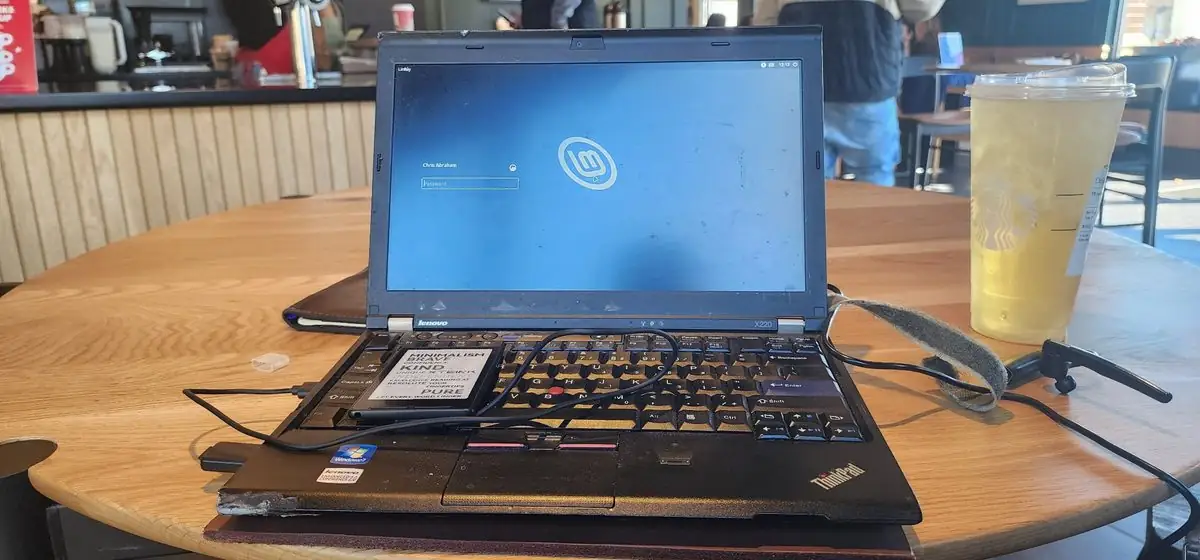
The workstation: the X220 at the Mint login, the X3 asleep on its keyboard, and a tall iced drink standing by. Photo by Chris.
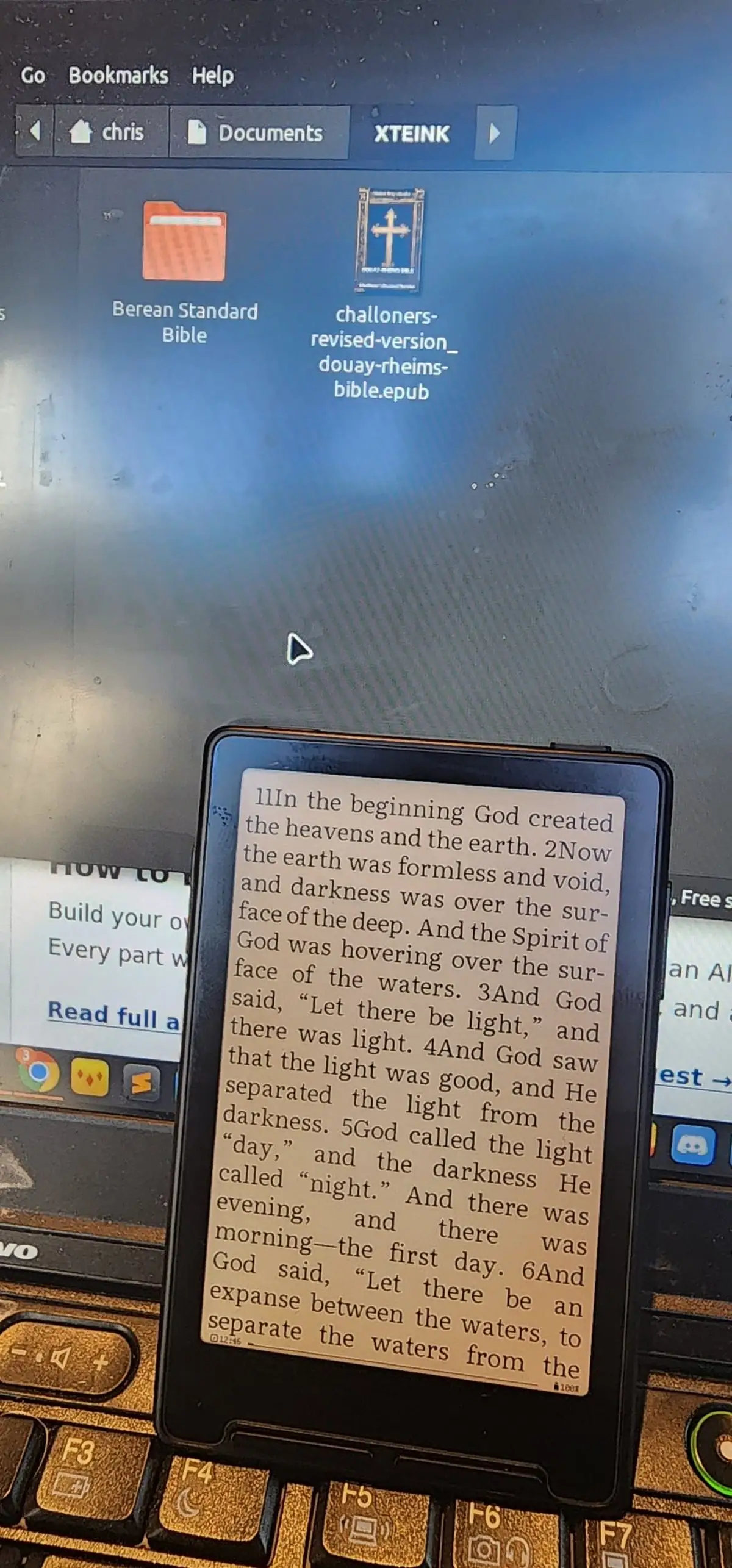
The proof: the X3 open at Genesis 1, the Berean Standard Bible on the device and reading. Photo by Chris, licensed CC BY-NC-SA 4.0.
So, Jason: no Kindle app, no store, no DRM, and that absence is the point. The X3 at $69 and its bigger siblings sell a reader that takes your EPUBs from a card or over Wi-Fi and then leaves you alone with the book. A volunteer community wrote the software that makes the hardware sing, fought the company to a truce when it reached for the lock, and now steers the product from inside. Buy through Amazon or eBay, never direct, and the worst the experiment costs you is lunch money. The canon is free, the reader is cheap, and the phone on your back finally carries a book instead of a feed.
As an Amazon Associate I earn from qualifying purchases. About affiliate links