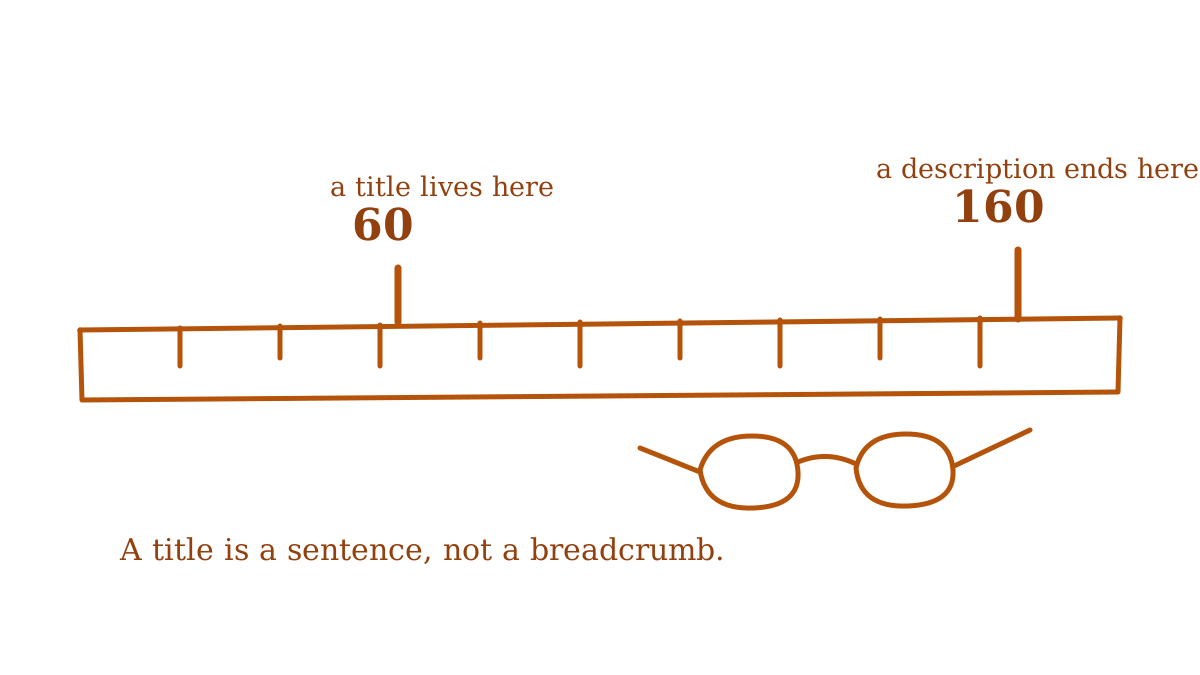
Here is my whole gospel in one paragraph, because a reader who stops after one paragraph should still get the religion. Titles run about sixty characters. Descriptions run about one hundred sixty. The brand name lives on the home page, the about page, and the contact page, and almost nowhere else, because nobody searches for your name except people who already know it, and the rest of the world searches for what you do. Titles carry no pipes, no dashes, no em dashes, because a title is a sentence and not a breadcrumb trail. Alt text describes the photograph, plainly, the way you would describe it to a blind man on the telephone, and the new fashion of stuffing brands and keywords into alt text is a lie told to exactly the person the alt text exists to serve. And the last article of the faith: half of this gospel can be set into a settings page and half of it cannot, and knowing which half is which is most of the job. Now the pluses and the minuses, article by article, because a gospel you cannot argue with is just a mood.
The numbers: sixty and one sixty
The pluses. Sixty characters is roughly what a search result shows before the scissors come out, and one hundred sixty is roughly what it shows under the title. Write to the space and your result prints whole, in your words, in your order, with the phrase the buyer actually typed sitting near the front where the eye lands first. The discipline is the real product. A sixty character budget forces the category phrase to the front of the title and pushes the furniture, the brand, the tagline, the city list, to the back or off the page entirely. Search engines are literal. They are lying liars that lie, and I wrote that in 2014 and it is still the whole game: if the exact phrase is not on the page, in the form the buyer asks it, the page does not come up for it. A short title cannot hide a missing phrase behind decoration.
The minuses, honestly stated. Characters are a proxy. The real limit is pixels, a wide W eats more room than three narrow i letters, and mobile cuts sooner than desktop, so sixty is a fence and not a law of physics. A title of sixty three characters that says the true thing beats a title of fifty eight that says the almost thing, and I have shipped both and slept fine. Descriptions do not rank a page at all, as far as anyone can prove; they are ad copy, the pitch under the title, and Google rewrites most of them anyway from the page's own text. So the one sixty is not a ranking spell. It is a courtesy to the reader and a leash on the writer, and a gospel should admit which of its commandments are physics and which are manners. Sixty is manners with good eyesight. One sixty is manners.
The brand stays home
The pluses. Brand names belong on the home page, the about page, and the contact page, because those are the pages a person who already knows your name is looking for, and they are welcome to it there. Everywhere else, the brand in the title is a tax. It spends your sixty characters announcing the one fact your customer does not need, you, instead of the thing he typed, which is the service, the place, the problem. Showing up for your own name is narcissistic visibility. You were always going to win that search. The searches that pay are the category searches, and they are won with the category's own words, asked the way buyers ask them.
The minuses. There is one honest exception and it has a name: reputation defense. When a brand is under attack, when the first page of its own name is a battlefield, brand pages multiply on purpose and the gospel steps aside, because that is a different job with different rules and I have done that job for years. There is also the coined name problem: a company whose brand is the category, the Kleenex case, gets to break the rule because for them the brand is the search term. And a local business whose customers genuinely search for it by name plus town should keep the name where the town is. A gospel that cannot name its exceptions will be broken by the first client who is one.
No pipes, no dashes, no em dashes
The pluses. A pipe is scaffolding left on the building. A dash separator is a room divider dragged into a sentence. Every separator burns characters on furniture and makes the title read like a filing cabinet instead of a claim. A title should read the way a person talks: a statement, with a colon if it needs a hinge, because a colon is punctuation and a pipe is plumbing. The rule also travels. Meta descriptions, headings, alt text: prose, not joinery.
The minuses. Big publishers run pipes as a house style and rank perfectly well, because the rule is about waste and voice, not about a ranking factor anyone can measure. If your site has ten thousand legacy titles with separators, the rewrite is rarely the first dollar to spend; indexing, dilution, and thin pages starve ahead of punctuation in every real diagnosis I have ever run. And I will confess the border in my own practice: I allow myself the colon and I use it constantly. A man is entitled to one hinge.
Alt text describes the picture
Alt text exists for the reader who cannot see the image. That is not a metaphor and it is not an SEO surface that happens to have an accessibility excuse. It is the other way around. The test I have used for years is the Lynx test: render the page in a text browser, the way a screen reader's owner meets it, and read the alt text aloud in the flow of the page. If it sounds like a description of the photograph, it passes. If it sounds like an advertisement that wandered into the wrong attribute, it fails, and the person it fails is blind.
Which is why the newest fashion in the tooling worries me. The current generation of AI alt generators advertises, as a feature, that it pulls your focus keyword into the alt text, and the brand stuffing follows naturally behind it: descriptions that name the company, the product line, and the target phrase, wrapped around a picture of a man holding a wrench. That is keyword stuffing in the one attribute where stuffing is also a small cruelty. My own field experience runs the other way. I have had excellent success with AI alt generators when they simply describe what is in the photo, loosely or strictly following the ADA idea: say what the image shows, say nothing it does not show, and stop. And my single best experience was not on WordPress at all. On Duda, the site builder, the built in auto AI alt generation produced alt text I could not improve by hand, and the site scored a perfect score on its alt text when the checkers ran. A platform that treats alt as description, generated at the moment of upload, quietly, got a perfect score. That is the bar, and it is not a high bar. It is just an honest one.
Little reviews, since I was asked
One correction of emphasis before these, because accuracy matters more than smoothness: of everything listed below, I have used only Duda’s built in generator. The rest are listed from their claims and their prices and what I have heard, not reviewed from my own use.
AltText.ai is the credit based service everyone in this trade has heard of, one credit per image, a WordPress plugin that backfills a whole media library and writes alt on upload, at prices running from $49 a year for 1,200 credits up to agency tiers. It is the category standard and the bulk backfill is genuinely good. Its advertised virtue is also its temptation: it integrates with Yoast and Rank Math to work your focus keyword into the alt, which is the stuffing I just argued against, so run it as a describer and switch the keyword habit off in your own practice.
Duda's built in alt AI is the one I would copy. No credits, no plugin, no ceremony: the builder writes a plain description when the image lands on the page, and my experience of it is the perfect score above. Platform builders can beat plugins at this because they meet the image at the door.
Yoast SEO Premium added AI generation for titles and descriptions, and good for them, it is the right surface for it, an editor suggesting the sentence you are already writing. But it writes no alt text, and here is my genuine question, asked as a Yoast man of long standing: why hasn't Yoast added this yet? Yoast already checks your images, already nags you when the alt attribute is empty or missing the keyphrase, already owns the exact moment in the workflow where a tired editor would gratefully accept a drafted description. The vision models are a commodity. The gap is not technical. My guess, printed as a guess, is that alt text sits in the accessibility team's conscience and the SEO team's checklist at the same time, owned by both and shipped by neither, and the specialists and the platform builders walked through the open door while the meeting continued.
SEOPress PRO is the bulk worker for titles and descriptions: $49 a year a site, real bulk generation across hundreds of pages, and your choice of paying with your own provider key or their credits. When the job is a thousand empty meta fields on a client site, this is the tool that respects the scale of the job.
Rank Math's Content AI does the same generation inside Rank Math, credit based, including bulk meta for selected items. If a site already runs Rank Math it is the path of least resistance, and path of least resistance is a legitimate engineering argument.
AI SEO Tools, a free WordPress.org plugin, is the wildcard that fits my economics: both jobs, alt and meta, written into whichever SEO plugin's fields you already use, running on your own API key at fractions of a cent an image, with command line commands so a big backfill becomes a script. Newer and less proven than the names above, and the one I would trial second, right after the describer that has already earned it.
What you can set, and what you cannot
Here is the part of the gospel nobody prints. Some of it can be turned into settings, and the settings are worth setting. A title template in Yoast or SEOPress can hold the brand suffix off every page except the ones you exempt, which mechanizes the brand rule. A fixed separator choice mechanizes the furniture ban. A generator set to fill only empty alt attributes, and to describe rather than stuff, mechanizes the backfill without overwriting a human's good work. Character counters mechanize the warning, if not the obedience.
And some of it cannot be set, because it is not a setting shaped thing. No settings page knows the phrase your buyer types at midnight. No toggle supplies taste: the same generator that describes beautifully on one library will stuff cheerfully on another if the keyword feature is on, and the difference between those two runs is a judgment, not a configuration. No counter writes the sentence. And no template survives the edge pages, the product whose name is the category phrase, the town whose name is the service, without a person reading the output before it ships under a client's name. You can set the fences. You cannot set the judgment that walks between them. My gospel, in the end, is a habit wearing a template: sixty and one sixty as the fence, the brand at home as the fence, description as the fence, and a person, reading it via Lynx in his head, as the whole point of the fences. Set what can be set. Then go read the page the way the reader who needs it most will meet it, and fix what the settings could not see.
Update, November 12, 2026, 1058: the little reviews below were first published in language implying my own use and endorsement of tools I have not used. Of the tools named, I have used only Duda’s built in alt text generator. A framing note has been added at the head of the section, and the companion post, AI SEO Tools for WordPress: A Field Guide for My Future Self, carries the full corrected list.