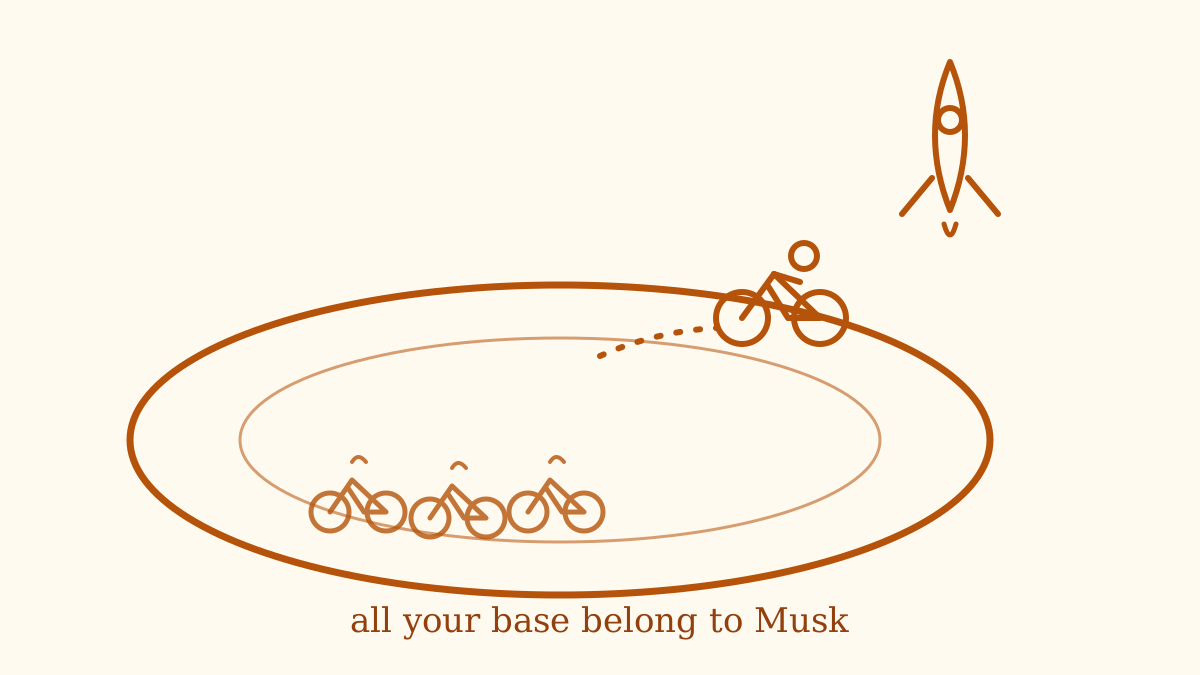
Elon Musk eats everybody's lunch, daily, in market after market, and the lunch is opt-in: 13.6 million Starlink subscribers who chose him, $11.387 billion of filed 2025 revenue, two of every three active satellites in orbit, 21 airlines, entire cruise fleets, the largest container line on earth, and allied governments paying retail for his terminals in a war. Nobody conscripted a single one of them. They looked at the incumbent offering, looked at his, and signed. The mechanism is simple, and it has nothing to do with genius. Elon Musk is the only rider in every race he enters who is willing to start it. Every industry he has touched was sitting in a velodrome, riding in circles at walking pace, conserving energy for a sprint that was never going to happen, because the whole field had quietly agreed that nobody would ever start. Then Musk starts. All your base belong to Musk because Musk is the one who goes.
The velodrome
A match sprint on a velodrome is the strangest race in sports. Two riders, three laps, and for most of it they go super slow, super slow, super slow, sometimes stopping dead on the banking in a track stand, each refusing to move. The physics are the strategy: the rider in front does all the work, punching the hole in the air, and the rider behind rides free in the slipstream and slingshots past at the line. Leading is losing. The rational rider never leads. He waits, he watches, he preserves every watt for the last two hundred meters, and the race happens only in its final seconds. Now scale it up to an industry. A market of incumbents is a velodrome with a hundred riders, and the same physics apply with the signs flipped for the customer: whoever innovates first does all the work, spends all the money, educates the market, absorbs the failures, and shows every competitor exactly where the money is, in time for them to draft behind him and contest the sprint. The rational incumbent never leads. He waits. His whole strategy is the last two hundred meters of a race that requires somebody else to ride the first nine thousand eight hundred.
And in the marketplace, the sprint never happens, because the race never starts. Everybody is hoping that nobody ever exceeds market rate. The field rides in its circle year after year, collecting its fees at the speed of its slowest member, and calls the circle a strategy.
Technology fixing
Price-fixing is illegal. Companies may not meet in a room and agree to hold a price. So they do something better, something no prosecutor can indict: they technology-fix. The agreement is never signed and never spoken. It is simply understood, across an entire industry, that the technology will move at the pace the incumbents find comfortable, that this year's product will be last year's product with a new badge, that capital will go to dividends and buybacks and lobbying, and that anyone who breaks ranks and actually builds the future will be treated as a vandal. Technology fixing is why the American phone business spent a decade as a global joke. I watched it from three countries. In the 1990s Japan was mocking us, mocking Europe too, because Japanese networks had early versions of everything. I was in England in 1990 when a mobile phone was a rumor; I came back in 1996 and the whole country had Nokias and Ericssons in hand and was obsessed with text messaging, doing casually what Americans would not normalize until BlackBerry, years later. In between I crewed a catamaran from Acapulco to Los Angeles, a boat Mark Harrison and I piloted up the coast, and I tried desperately to text my girlfriend Wendy from the sea, and America answered as one: nobody liked texts, nobody wanted texts. The carriers sat perfectly still for ten years and charged exorbitantly for the sitting. That is technology fixing with a billing department.
The pattern repeats everywhere you look, because the velodrome is everywhere. Detroit technology-fixed the automobile for decades, and the sovereign projects technology-fix from the statehouse: Europe's IRIS² constellation has consumed a budget that grew from €6 billion to €15.6 billion and has deployed zero satellites, with service promised for 2032; China's Qianfan promised 648 satellites by the end of 2025 and delivered 108. A state peloton rides even slower than a corporate one, because its riders are promoted for never falling off.
The man who starts
Musk's entire method is the refusal to ride in the circle. If you cannot win the red tape war on the terrestrial world, leave the terrestrial world. Electric cars when Detroit swore the economics were impossible. Reusable rockets when the launch industry charged governments by the pound and threw the rocket away. Tunnels instead of highways. A satellite network built at 70 satellites a week and 15,000 terminals a day, in his own factories, launched on his own rockets, 165 flights in 2025 alone, while his largest broadband rival, Amazon, has launched 396 satellites total and buys Falcon 9 launches from him to do it. That arrangement is the velodrome in one image: the peloton, chasing the breakaway rider, on bicycles the breakaway rider sold them. Musk pays the front-rider's price every time, in public, with his own money, years before the revenue exists. The industry calls this recklessness right up until the moment it becomes the industry standard, at which point the industry calls it inevitable and asks why nobody can compete with him.
The peloton's defenders reach for invention, the last refuge of a field that lost. Australia pioneered satellite internet for the outback, a man told me this week, as if the patent were the prize. HughesNet and Viasat were selling satellite internet years before Starlink existed, and they still are. Between them, in Ookla's Q3 2025 count, they account for 2.7 percent of the world's satellite speed tests. Starlink accounts for 97 percent. Invention is a museum category. Capture is the market, and the capture is total.
Every class of customer ratifies the break. Households buy Starlink against cable monopolies and against nothing at all. United is putting it on more than a thousand aircraft and giving it away free to its loyalty members, which means the airline pays Musk so its passengers will choose the airline. Carnival put it on 100 percent of its ships. Maersk put it on 330 container ships after a 30-ship pilot, which is how purchasing departments say the pilot embarrassed the incumbent. In Ukraine, about 85 percent of the terminals were paid for by allied governments and charities; Poland alone funds some 20,000 terminals at about $50 million a year. Investors paid $75 billion for primary shares at the June IPO. And at the top of the market the product is pure insurance: every rich man I know keeps a Starlink as the backup feed behind his terrestrial line, paying Musk a monthly standby fee for a service he hopes never to use, there for the day the ground network dies. One friend of mine runs Starlinks on all of his Suburbans, the whole executive fleet, roof-mounted and always on. The limousine trade tells the same story in miniature: limo services used to bolt little television dishes to their cars to pull down satellite TV; the dishes are gone, the cars stream their video over Starlink, and in that niche the constellation replaced even Dish Network. Eating everybody's lunch turns out to be a catering business: the lunch is served, the price is posted, and the line forms voluntarily, because the other cafeteria was serving 1996.
Stepping stones
There is an old cartoon where the jungle hero does not swing across the river. He runs across it, full sprint, on the backs of turtles and hippos and crocodiles, one step per animal, never stopping, because stopping is sinking. That is the Musk portfolio in one gag. Every product is a back to step on. The Cybertruck was a passion project until it was a stone; the Model S and the Plaid were stones; the stones are not the destination and they never were. Tesla the car company turns out to be a stone too: the company now cares about autonomous taxi cabs, and behind the taxis it is already stepping toward robotics, toward the autonomous butler. Each venture gets his full weight exactly as long as it takes to cross it, and then his weight is somewhere else. Ford and General Motors and Dodge cannot do this. They are automobile manufacturers and only automobile manufacturers, one river, one stone, forever. The Japanese and Korean giants can, in structure: Mitsubishi and Hyundai and Honda and Suzuki and Toyota are diversified megaliths whose cars are one division among many. Musk has their structure with a single man's attention span as the connective tissue, and the attention is the asset. It is all the Elon Musk show. The investment follows the man, not the stone; the boards he leaves behind are staffed by believers precisely because the money believes. Which carries the risk he would be the first to name: he is fickle, he loses interest, the ADHD moves on, and when it does the money moves with him, out of the stone he has finished crossing and into the next one, and the stone is left to whoever he left it to.
The next bottleneck
The stones are not the pattern. The pattern is the bottleneck, and Musk builds whatever stands between him and the crossing. I believe the only reason SpaceX was ever created was to break the bottleneck of getting 11,000, or 15,000, satellites into orbit: the constellation was the goal and the rocket company is the road he had to pave to reach it. Today's bottleneck is silicon. Chips, processors, video memory: his whole empire runs on other men's wafers, priced by other men's pelotons, and my genius mogul buddy David laid out the obvious sequel over my shoulder months ago. Musk will build fabs. He will make his own wafers and take on Nvidia and Taiwan, because a man who paves his own roads does not rent his chips. He will go after the bespoke fabricating machines themselves, the absurdly overpriced one-off instruments the tooling oligopoly guards, and build the factories that make the fabricators cheaper. Then the inputs: silicon, rare earths, mining, the whole stack owned up and down, quite possibly with South Africa in the plan, where his roots and the minerals both are. That is speculation, mine by way of David, and I print it as speculation.
The record has already graded half of it. In March 2026 Musk announced Terafab, Tesla and SpaceX and xAI together, Intel in by April: logic, memory, and packaging under one roof in Texas, a prototype fab at Giga Texas and the main plant in Grimes County, up to $119 billion at full buildout, four-fifths of the output earmarked for SpaceX's orbital AI and the rest for Tesla's cars and robots. David called the motive and missed the map. One machine even the breakaway rider drafts behind: ASML's extreme ultraviolet lithography, a Dutch monopoly at $350 to $400 million per machine, thirty years of physics in a box. Musk praised ASML in public, bought expedited shipments, and put the machine-replacing off to phase two. The South Africa instinct survives as minerals, rare earths for magnets, because a fab needs a power grid that never blinks and South Africa's blinks for a living. The lesson stands anyway, and it is the whole essay in miniature: do not watch his product lines. Watch his toll booths. Wherever his supply chain pays a toll, a factory is coming, and the peloton standing at that booth is already history.
Atlas, rewritten
There is an extreme amount of Atlas Shrugged in all of this, and one decisive edit. Rand's novel is alloys and railroads: Rearden Metal, the revolutionary alloy every expert declared unsafe, and Dagny Taggart building her line out of it while the regulatory state and her own brother grind her down. Her producers' answer, in the end, is John Galt's strike. The competent withdraw. They vanish to a valley and let the world discover what it lost. Musk is what happens when Ayn Rand writes a novel where the protagonist wins and isn't crushed by bureaucracy and status quo. He never has a Galt problem, because he never goes on strike and never asks the valley for permission. He is too rich to withdraw and too stubborn to vanish, so he does the thing Rand's heroes were never allowed to do inside the world of the novel: he stays, he builds the railroad anyway, and he builds it out of his own alloy, except the railroad is a constellation and the alloy is a rocket that lands itself. Near the climax of the novel, Galt hijacks the national radio network to deliver a three-hour speech over the heads of every gatekeeper. Musk bought the network. Galt's Gulch was a hiding place. Starlink is the opposite of a hiding place. It is the gulch, industrialized, put into orbit, and sold by subscription to the very world the strikers abandoned, at $10 a month for the phone plan, carriers included as resellers.
The companion piece to this one is the boring shit, and it matters, because it shows the peloton's last line of defense. When the carriers finally moved this October, they moved the only way a velodrome knows how: they asked the officials to penalize the breakaway, filing to strip 60 percent of the new spectrum from the FCC's proposal before the vote. That article, Just the Tip, is the licensing record, and the Objective Daily News special report files the full count. This article is the simpler truth underneath both. Industries do not lose to Elon Musk. They forfeit to him, one unridden race at a time, conserving their energy in a circle while he rides out of the stadium and into orbit. All your base belong to Musk, because Musk is the only one who ever tried to take them.
Update, November 12, 2026, 0847: after the first draft of this post was filed, Chris kept dictating, and the morning's later material was folded in on his instruction: the invention-versus-capture answer to the Australia thread (Ookla speed-test shares), the standby-fee and Suburban exhibits, the limousine-dish note, the stepping-stones section, the next-bottleneck section (David's fab prediction, printed as Chris' speculation, against the announced Terafab record), and the Galt radio beat in the Atlas section. The headline was also shortened at the desk to fit the site's title limit.