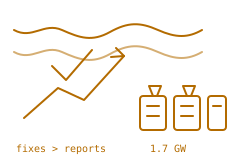
Monday's verdict is that the AI flood is becoming plumbing, and plumbing has a price in atoms. Linus Torvalds released Linux 7.4-rc2 on November 8 and reported that in the eBPF subsystem, fixes are now landing faster than fresh AI-generated bug reports arrive, after a record rc1 of about 19,671 commits that included 3,008 AI-assisted commits, 2.4 times the prior cycle. The Financial Times reported on November 8 that Anthropic committed about $3.4 billion in late September for 1.7 gigawatts of Caterpillar gas generators, taking over orders OnePWR Solutions placed about two years ago; Anthropic and OnePWR did not comment and Reuters could not verify the report. Physical Superintelligence, PSI, announced on November 6 that a research system running an unreleased Anthropic model proved the Aaronson-Ambainis conjecture, open since 2008, with the proof checked step by step in Lean and published with the formal proof; the paper is not peer-reviewed and neither Aaronson nor Ambainis had commented as of November 7. NVIDIA announced on November 9 an expanded sovereign AI collaboration with Korea's Ministry of Science and ICT, centered on Rebellions' R200 processors linked through NVLink Fusion, with deployment at SK Telecom expected in 2028. A November 8 reading of the Justice Department's October 13 memorandum shows the new Super Intelligence Task Force, announced November 5, absorbs the January task force whose sole job was challenging state AI laws, while its founding term is never defined. And Marie Haynes documented Search Console clicks spiking 2 times to 6.5 times between October 31 and November 2 while impressions stayed flat, on deep pages at 45% to 100% click-through rates, which is automated traffic in the report, not customers.
Torvalds: Linux 7.4-rc2, and the AI patch flood may have peaked
Linux 7.4-rc2 arrived on November 8, 2026, reported November 9. Torvalds called rc2 a big release, partly because he held work back from an already record rc1, and called its diffstat “fairly benign,” with changes spread across subsystems. The number that matters is in eBPF, the kernel technology that runs small sandboxed programs for networking, observability, and security: fixes are now landing faster than new AI-generated bug reports arrive, an observation backed by eBPF lead developer Alexei Starovoitov. The context is the cycle's scale. Rc1 carried about 19,671 commits against a typical 15,000, and 3,008 non-merge commits carried AI assistance, about 2.4 times the 7.3 cycle. Torvalds' standing position, repeated this cycle, is that AI work belongs in the merge window as normal development, not dumped into the stabilization period, and that human review and sign-off remain required.
This is the standing Torvalds watch paying off in one data point, and the practitioner chair should not overread it. One subsystem clearing its backlog is not the whole kernel clearing its backlog, and rc2 is one week. What it does show is a working model that other projects can copy: let the machines find and draft early, keep humans as the gate, and measure success by whether the fix rate passes the report rate. That is a management result, not a model result, and it is the first time this year the flood metaphor has run in the other direction.
Anthropic: a reported $3.4 billion for 1.7 GW of gas generators
The Financial Times reported on Sunday, November 8 that Anthropic agreed in late September to pay about $3.4 billion for 1.7 gigawatts of heavy-duty gas-fired generators, by taking over Caterpillar orders that San Antonio developer OnePWR Solutions placed about two years earlier and needed financing to complete. The FT called it the largest known single purchase of power-generation equipment by an AI lab. Anthropic did not acquire OnePWR and no employees transferred, but the deal includes the engineering and construction work to install the machines. Piper Sandler, OnePWR's adviser, lists a completed $3.4 billion sale of OnePWR's power generation platform to a frontier AI lab without naming the buyer. At the reported figures the price is roughly $2,000 per kilowatt. No sites and no delivery schedule have been disclosed. Anthropic and OnePWR did not respond to requests for comment, and Reuters said it could not immediately verify the report. Anthropic's amended S-1, filed November 2, says access to electricity limits data center expansion in several markets and that new power sources and grid connections can take years.
The lab stopped renting the scarce thing and bought its place in line for it, and the public-interest chair asks the only question left: who pays, and where. Behind-the-meter gas generation moves the cost and the emissions off the grid's books and onto the site's permits, which have not been named. That does not make the move wrong. It makes the next documents the story: site names, air permits, and local terms. For every business watching the AI buildout, the lesson is already plain. Compute is no longer the constraint that decides who ships. Power is, and power is bought years ahead, in gigawatts, at billions per gigawatt.
PSI: an AI system and a Lean-checked proof settle an 18-year quantum conjecture
Physical Superintelligence, a Cambridge, Massachusetts AI-native physics laboratory that came out of stealth on September 1 with a $58 million seed round led by Breakthrough Energy Ventures, published on November 6 a proof of the Aaronson-Ambainis conjecture. Scott Aaronson and Andris Ambainis posed the problem around 2008. In plain terms it asks whether a quantum computer can be exponentially faster than an ordinary computer on random, unstructured inputs. PSI says its internal research system, running instances of a non-public Anthropic model it does not name, produced a complete proof on the third day of a run, then improved the result twice on related problems. The proof assistant Lean, which checks every logical step, accepted the final version, and PSI published the paper and the full formal proof on GitHub. The work was led by a member of PSI's technical staff, David Turturean. Four Stanford researchers who settled a special case in August have read the proof and are writing a short exposition. The paper has not been peer-reviewed, and neither Aaronson nor Ambainis had commented as of November 7.
Label the layers, because this paper's frontier beat lives or dies on the labels. What is shown: a formal proof exists in a machine-checked form anyone can download and recheck, which is a stronger exhibit than a press claim. What is claimed: that an AI system found it in three days, on an unnamed model no outsider can test. What follows if the proof stands: exponential quantum speedups require structure in the input, as Shor's factoring algorithm exploits, and anyone promising exponential gains on messy data now has to name the pattern. That is inquiry at its best, a strange claim with its exhibit attached and its open questions still open.
NVIDIA and Korea: sovereign AI racks that mix GPUs and Korean NPUs
NVIDIA announced on November 9, 2026 an expanded collaboration with Korea's Ministry of Science and ICT covering chips, data centers, models, skills, and agent security. The hardware center is Rebellions' next-generation Rebel R200 neural processing units, connected to NVIDIA's platform through NVLink Fusion and built into rack-scale systems on the MGX architecture. The plan splits inference: NVIDIA GPUs handle prefill, Rebellions NPUs handle decode, aiming at lower latency and better power efficiency on frontier models. SK Telecom plans to deploy the systems in its AI data center, with readiness expected in 2028. The software side is ready sooner: deployment recipes for four Korean foundation models, SK Telecom's A.X K2, LG AI Research's K-EXAONE 2.0, Upstage's Solar Open 2, and Motif Technologies' Motif-3, with NVIDIA reporting up to 2 times out-of-the-box performance on B200 GPUs. On agent security, Hyundai Motor Group is exploring NemoClaw blueprints and the OpenShell runtime, and AIM Intelligence is integrating its Starfort agent-control platform with OpenShell.
Sovereign AI used to mean a country buying American GPUs and calling the room national. This is the more serious version. Korea keeps its own silicon in the rack, its own models in production, and its own security layer around agents, while NVIDIA keeps the interconnect and the rack standard. Lessig's chair reads the architecture as the policy: whoever owns the link between the chips owns the terms everyone else builds on. For smaller countries and smaller companies alike, the copyable part is the split itself. Own the piece you can actually build, and rent the standard you cannot.
DOJ: the Super Intelligence Task Force absorbs the state-law unit
The Justice Department announced its Super Intelligence Task Force on November 5, framing it as enforcement against foreign states, transnational criminals, and fraudsters who misuse AI. A close reading published November 8 of the founding memorandum, signed by Attorney General Todd Blanche on October 13, shows the larger move. A footnote abolishes the Artificial Intelligence Task Force announced January 9, 2026 and moves its matters, work product, and personnel into the new body. That January unit's sole charge, under Executive Order 14365, was challenging state AI laws that conflict with federal policy. The new memo never mentions states, but it retains affirmative civil litigation on SI and instructs the group to advise on proposals that promote SI innovation without burdensome regulation. Its six functions include organizing criminal and civil enforcement, recommending priorities, and developing prosecution and compliance guidance. Neither the memo nor the release defines Super Intelligence, the term the September 29 executive order substitutes for artificial intelligence. Co-chairs are Associate Attorney General Stanley Woodward and Associate Deputy Attorney General Stephen Weiss.
Godwin and Lessig take this one together, because the name is a joke and the merger is not. An undefined term means the scope of “matters involving SI” is whatever the department says it is, from chatbot phishing to a suit against a state safety statute, and the same office now runs both the fraud cases and the federalism cases. The practical signal for companies is in the compliance line: the department wants vigorous internal controls so the technology behaves as intended, and DOJ guidance has a long history of becoming the standard companies build to without any law passing. Watch for the first published guidance and the first case filed under the new banner. Those two documents will say what this task force is.
Search Console: the November click spikes were bots, not buyers
Marie Haynes published the row-level evidence in Search Engine Journal. Between October 31 and November 2, several sites saw Search Console clicks jump 2 times to 6.5 times while impressions and rankings stayed flat. One multi-location service business went from about 50 clicks a day to 327 on November 2, a 6.5 times jump and 14.1 times on desktop, across 120 pages, while mobile clicks stayed at 30, inside its normal 25 to 40 range. The clicks landed on pages ranking in positions 12 to 54, pages 2 to 6, at 45% to 100% click-through rates that deep pages never earn from people. On one technical site, a single page took 40 Canadian clicks across 23 slightly reworded variations of one question, at an 80% rate in position 14.6, while its United States clicks on that page stayed at zero. Haynes lists four candidate causes, from click-through scrapers and decoy-click networks to AI agent query fan-out and a gap in Google's bot filtering. Google had not confirmed a cause in the reporting. The filters are practical: check the mobile trendline, filter the Pages tab to positions greater than 10, and exclude a spiked URL or country to clean the chart.
This is the home-galaxy item, and it lands directly on Chris' client work. A click spike with flat impressions, flat calls, and flat bookings is not growth, and any report that celebrates it will have to be unwritten in December. The discipline is the same one this paper applied to People Inc. yesterday from the other side: count the money event, not the landlord's counter. Annotate early November in every client report now, while the dates are known, and teach every business owner the two tells, desktop-only and deep-page, before a dashboard teaches them the wrong lesson.
What the day adds up to
Monday adds up to a flood becoming infrastructure, with the bill and the rulebook arriving together. The kernel's fix rate passed its AI report rate in one subsystem, under human sign-off. A lab reportedly paid $3.4 billion for 1.7 gigawatts of generators because the grid could not arrive in time. A machine-checked proof, if it stands, drew the boundary of quantum speedup at structure in the data. Korea put its own chips inside the standard rack instead of merely buying the rack. The Justice Department folded its state-law campaign into an undefined new task force. And the month's happiest Search Console charts turned out to be bots clicking page 4. None of these stories is about a smarter chatbot. All of them are about what the chatbot economy costs, who controls it, and which numbers in it can be trusted.
Sources: Crypto Briefing on Linux 7.4-rc2, November 9, 2026, reporting Torvalds' November 8 release and XenoSpectrum's commit count; Financial Times on Anthropic and OnePWR, November 8, 2026, via MLQ and Reuters, neither company commented and Reuters could not verify; Physical Superintelligence announcement, November 6, 2026, via Quantum Zeitgeist, paper not peer-reviewed; NVIDIA and Korea MSIT joint announcement, November 9, 2026, via Unite.AI; Justice Department memorandum of October 13, 2026 and November 5 announcement, read in full November 8, 2026 via GetAIBook; Marie Haynes in Search Engine Journal, November 2026, row-level Search Console data through November 2, 2026.