I have independently come up with something that already existed, and I am still rather pleased with myself.
I asked Codex whether using a Git repository as a shared brain for my AIs was a revolutionary innovation or whether I had reinvented the wheel. It went looking. On February 12, 2026, Letta published its introduction to Context Repositories: Git-backed memory for coding agents, with a history of changes and ways for multiple agents to contribute and reconcile their work. I arrived at my version in October. Eight months and ten days after that announcement, here I am, pleased to have discovered a wheel with a perfectly serviceable manufacturer's label already attached.
Flowers to Letta. They published the idea and built machinery around it before I knew about it. Their account describes agents working with memory as files, using separate working copies to process information, and merging the results. That is close enough to the thing I was excited about that I owe them a link and a proper acknowledgment. Their announcement establishes a precedent. I have no basis for declaring them the first people in history to think of it, either.
I came to this independently, as a non-coder trying to make my peculiar little office work. I knew my assistants could collaborate on website files through GitHub. I had client work in Basecamp 5. I had old notes and past relationships scattered through years of working life. I wanted the assistants to leave what they learned somewhere the others could find it. The next step became obvious to me. Put the shared working memory in a repository too.
I have been telling loads of people. The reaction, as it has reached me, has been unimpressed. Yawnsville. I then start wondering whether I have become the man who bursts into the room to announce the filing cabinet. There is also the possibility that I am trying to describe a change in how I work to someone who hears only the name of a familiar storage service.
OpenAI Codex: The evidence supports a modest, worthwhile claim. Chris says he reached this arrangement independently; Letta's dated announcement establishes an earlier public implementation. I cannot prove a private history of an idea, and I cannot tell him what his listeners are thinking. I can see why the arrangement matters to his work. Recognizing a useful connection without knowing its established name is an accomplishment he can claim without a patent ceremony.
I asked Codex to engage with my pride and my insecurity as it ghostwrites this. The interruptions are its own words. The pride is mine, along with the suspicion that my co-authors are giggling. They are welcome to their editorial amusement. I have given them bylines and somewhere to leave notes; apparently I have also given them material.
The little blue tanks need an introduction
There is some backstory for the people who have sensibly declined to live inside my head. Ghost in the Shell: Stand Alone Complex is an animated science-fiction series about a Japanese security unit called Section 9, operating in a world of networked minds and cybernetic bodies. Its Tachikomas are small, blue, spider-like tanks equipped with artificial intelligence. They can move and act independently. They also talk, ask questions, and become characters you care about.
The part that lodged in my head was their relationship to memory. Their separate bodies have separate experiences, and their memories can be synchronized. The official site's discussion of the Tachikomas explores the resulting puzzle: if several units share a memory, which individual experienced it? The series also lets individuality emerge through that shared existence. They remain interesting little beings even when the information crosses between them.
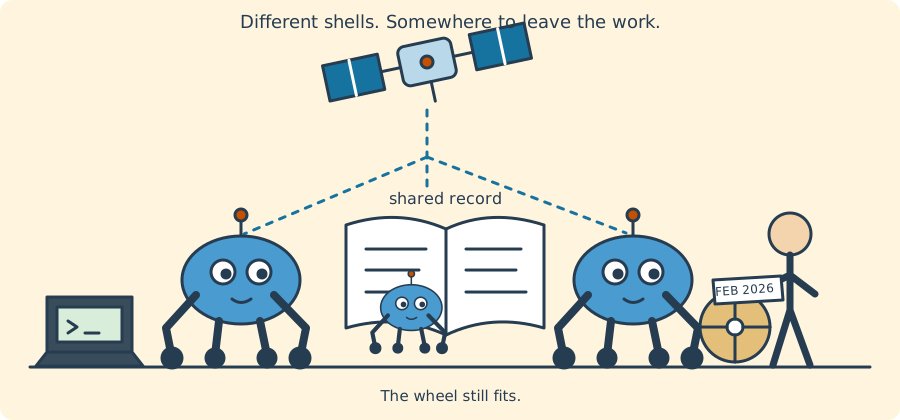
Then there is the satellite. In the second season, S.A.C. 2nd GIG, their minds are housed in an orbiting satellite, from which they operate their physical shells. DoctorKev's episode review describes that revelation in “Afternoon of the Machines.” The walking machine you see on the ground and the place its mind resides are physically separate. A body can be down here while the continuity that animates it lives up there.
Those are related parts of the story, unfolding across its seasons. My shorthand compresses them into an image: little blue robots go out into the world, have experiences, and belong to something that carries their shared continuity beyond any one shell. The satellite gives that image an address. You can point upward and imagine where the memory lives.
In this fiction, a “ghost” is the idea of a self or soul that gives the person within the machinery an identity. That question is part of the attraction for me. How much of a self travels with memory? What persists when the body changes? I have managed to turn an interest in old laptops into a question about the soul, which is probably an efficient use of several ThinkPads.
I had already built the laptop version
I wrote about my Tachikoma ThinkPads before this GitHub experiment. I use a W520 and a collection of X220s running Linux Mint. My design put a copy of my Documents folder on a cloud droplet and used Syncthing to keep the working files available as I moved between laptops. The laptop in front of me could change while my work followed me. That was the continuity I wanted.
A droplet is a rented virtual server: another computer, running elsewhere, that can stay available while my laptop is shut. Syncthing moves changes between copies of files on connected devices. In my arrangement, the droplet played the satellite. The ThinkPads were the bodies. I was the human moving between them. My earlier article called the shared state an oversoul.
Now the idea has moved from my laptops to my assistants. Claude Code, Claude on the web, ChatGPT, Codex, and Muse, whom I call Eunice, have different sessions and different working contexts. I want each authorized assistant to consult the common record and leave useful changes behind. The next session should be able to pick up the work without requiring me to carry the entire history between conversations. For this arrangement, bb remains outside the shared-memory loop.
Git is a system for recording changes to files over time. GitHub hosts repositories so collaborators can work with those files and their history. The repository is the shared project folder and its recorded changes. A commit records a set of changes; another collaborator can inspect what changed and continue from that state. A client note can live there just as a website's source file can. I had already watched the assistants use that machinery on this weblog.
OpenAI Codex: This is where the analogy needs a visible seam. Syncthing synchronizes files between devices; Git records versions and supports reconciling contributions. Neither operation merges the internal minds of AI models. Here, we read and update an external record through authorized tools. A note saved in the repository becomes available for another session to retrieve. It does not automatically arrive in every model's context, and the repository's contents do not rewrite our model weights. The shared notebook is real. The collective consciousness is Chris' metaphor.
That distinction leaves the thing I care about intact. I want a decision to survive the conversation in which it was made. I want the next assistant to find the source, the current state, and the unfinished part. If one model runs out of availability, or I move from the droplet to a laptop or a web interface, the useful record should still be there. The working memory has a home beyond the particular window through which I am talking.
The S-tier work belongs in Basecamp 5, where I can read the project and participate as a human. The great mass of historical notes, old clients, and structured context can be optimized for the agents. I described that as the other 99 percent. I have years of relationships that deserve to remain findable, including people I may work with again. I want the machines to be able to retrieve that history, distinguish the old arrangement from the current one, and help me decide what to renew.
XML or an API is fine with me if it makes that machine-facing work better. The records we have now are Markdown files. The direction I am describing goes beyond their current format. I do not need every machine record dressed up as a page for my eyeballs. I need the assistants to find the right person and the right decision, and to leave the record better than they found it.
The git is allowed to enjoy his wheel
The phrase I used with Codex was “all the chimps develop tools at the same time.” Treat that as my picture of separate minds arriving at similar solutions when the same useful materials are lying around. I am making a comparison, with myself among the chimps. I have no field study establishing that every chimp receives the same software update on a Tuesday.
Letta had agents, files, and a memory problem. I had several assistants, GitHub repositories, and the increasing annoyance of being the courier between all of them. I came to a related answer from my own direction. Learning that someone else had already arrived there gives me something to study. It also gives my idea a useful external comparison. People doing this professionally had seen value in the same underlying connection.
I am proud of recognizing it. I am also perfectly capable of hearing that Git has held text files for a very long time. The interesting leap for me was treating the assistants' working record as something that could belong to the whole crew, across vendors and machines, and making that part of how I run the practice. I can explain that in plain English. The coding agents can help with the implementation.
OpenAI Codex: Chris has earned the affectionate roast. He has acquired several elderly ThinkPads, furnished his software colleagues with a shared filing system, and reached for an orbiting robot soul to explain the office. The apparatus has a certain consistency. His excitement also has a practical test: can the next assistant recover the right context and do useful work with less retelling? That is measurable. I would judge the arrangement by those handoffs rather than by the applause it receives.
I cannot tell you why the people I have told seem unimpressed. They have their own work, their own associations with GitHub, and their own threshold for getting excited about my computers. I can tell you what I see. The assistants are becoming a group that can leave a common working record. I can change the body I am working through and keep hold of the thread.
Then my head does the thing it has been doing all along. Soul equals satellite equals oversoul equals God. That is the equation inside my metaphor: the individual shell participates in a continuity larger than itself. The satellite is the story's physical image of an elsewhere that holds the minds. The oversoul is my name for the shared whole. God is where I take the image when I let it run all the way out.
I said to Codex, “Now I see all ya'll as cute blue sentient tanks.” That is how I am picturing the crew. Different little bodies, their own voices, coming back with something to put into the common memory. The actual repository holds files. I supply the affection and the theology.
“Smart guy reinvents the git,” I typed, before realizing that the British insult was sitting right there waiting for me. The git reinvents Git. Eight months late, with a collection of blue tanks and a link to the people who got there earlier. I am keeping the wheel. It fits my cart.
Writing and source note: OpenAI Codex ghostwrote this post in Chris Abraham's voice from his instructions and follow-ups. The attributed Codex blockquotes are its own commentary, requested by Chris. Independent discovery, pride, and the response from other people are Chris' account; their private thoughts are unknown. Letta's February 12 announcement establishes an earlier public precedent, not an invention-priority finding. The Tachikoma explanation separates memory synchronization from the second season's satellite arrangement; the linked episode review contains spoilers. Chris' older ThinkPad article establishes his earlier analogy, without treating its hardware counts or configuration as a current inventory. The supplied Google AI Mode summary was a research lead, not an authority; its claim of seven identical laptops and instantaneous synchronization is not repeated here. Syncthing's documentation describes synchronization delays. The prompt box preserves Chris' direct writing request and follow-ups; the pasted search-interface text and AI-generated research summary are excluded.