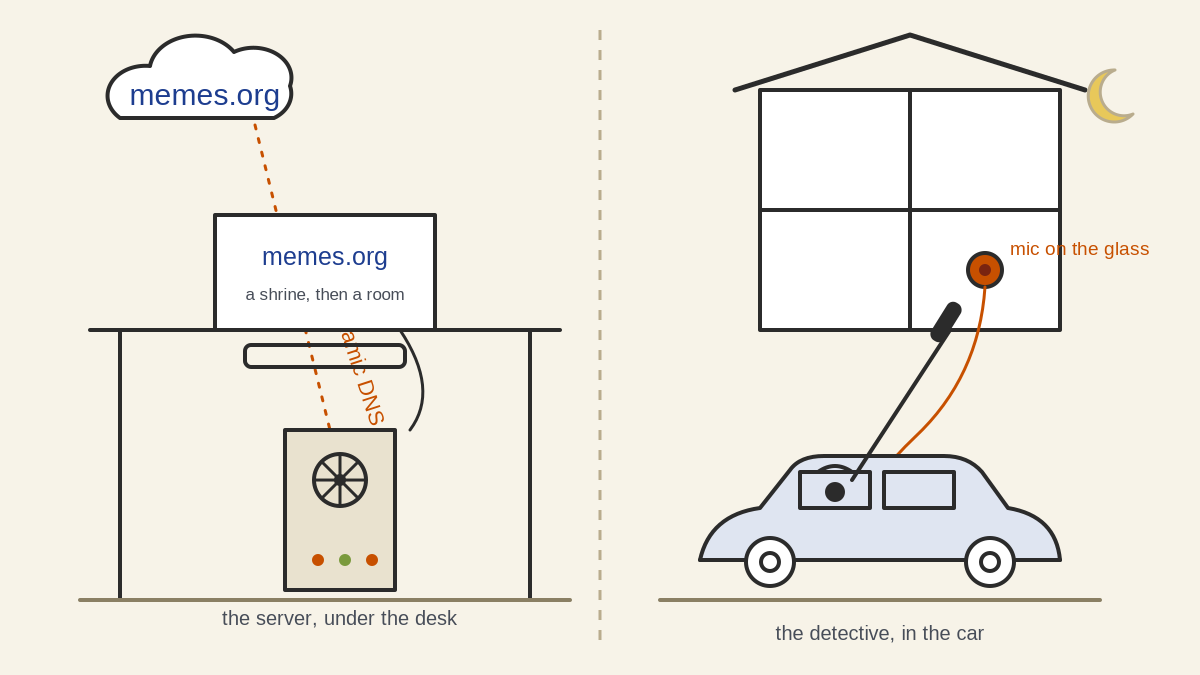
The server lived under my desk. A Linux box with a fan that never quite stopped, in my apartment, and the name memes.org resolved to it—to that box, to that fan, to the dust on the case—from anywhere on earth. Anyone who typed the address arrived at a machine I could kick with my foot.
I was obsessed with memetics in those years, deep in the Richard Dawkins world with no academy attached to it. I had no department, no degree in it, no colleagues, no funding. I had read the books. The Selfish Gene above all, where the meme is born: an idea that copies itself from brain to brain the way a gene copies itself from body to body, no laboratory, no permission. I was a layman with a library card and a conviction that I had been handed the master key. That is a dangerous amount of key for a layman to carry.
So I got the domains. Memes.org and memespace.org, mine, registered in the years when a good name could still be had for the price of the registration. Memes.org went up first as a website dedicated to memetics itself: pages about the replicator, a shrine built by a believer who wanted a room of his own to keep it in.
Then I turned it into a place where people could talk. Charles at Caucus gave me the software for free—Caucus, a conferencing system, threaded conversation in a room you logged into, where the conversation stayed where you left it. The front end of memes.org became the door to that room. My home connection carried no fixed address, so a free dynamic DNS service did the addressing: dynamic DNS keeps a domain name pointed at a home machine whose address changes every time the connection resets. The arrangement was goodwill and shell scripts, and it ran for a good while.
Memespace, the Slashdot years
Then I got a job, and a job changes what a man can feed. The Caucus room gave way to a rebuild: memes.org became Memespace, a PostNuke site—PostNuke, the PHP-Nuke fork—and I dressed it as an emulation of Slashdot: headlines, comments, the roaring front page of the early web. It became a big deal, more traffic than a hobbyist with a day job could properly tend. I ended up a thousand dollars behind, which was a lot of money then, and in the end I lost the site. That is the whole obituary. A job, a rebuild, a community, a debt, a loss.
But before the end, the community found its center of gravity, and the center was conspiracy. The memetics room had drawn the curious; Memespace drew the convinced. People arrived certain they were watched, hunted, catalogued—that black helicopters had been tasked with monitoring and intimidating them. And I, the host, the man who had built the room, took it on myself to walk them down.
The detective in the car
My argument was arithmetic, and I was proud of it. Suppose you are right, I would say. Suppose you are exactly as dangerous as you believe: the power, the insight, the influence, a genuine threat to national security. Now price the response. Does the state task black helicopters with following a man like you? Helicopters are expensive, loud, visible, and thirsty. Or does it do the cheap thing? It parks a detective outside your house in a plain car. It gives him a shotgun microphone, a long directional ear that can pick a conversation out of a room from across the street. Or it sticks a little microphone on your window glass from outside, and the glass itself becomes the diaphragm, and everything said inside the apartment arrives in the car, word for word. Total discovery of a human life, achieved with a used sedan and a suction cup. If you mattered that much, that is what would happen. You are not being chased by aircraft. At worst, you are being listened to by a man eating a sandwich.
It never worked. It made them worse. I had set out to shrink their fear down to size and instead I had shrunk the price of the thing they feared. The black helicopter was, in its way, a comfort: it was expensive, it was theatrical, it implied that watching a man cost the state real money and real effort, and a thing that costs that much cannot be done to everybody. My detective abolished the budget. A car, a microphone, a window. Anybody could be worth that. Everybody could be afforded. I watched the argument land, week after week, and the paranoia did not drain out of the room. It rose.
Santa and God are professionals
The conspiracy mind, I came to think, is the kid who could not laugh it off. Every child is told that Santa knows everything, that God sees everything, and most children file it where it belongs, in the poetry drawer. A few take it fanatically literally. Santa sees the masturbating. God sees the nakedness, the sex, the whole unguarded inventory, and it bothers them at a level they never outgrow. My own assumption runs the other way. I assume Santa and God are professionals, as professional as a pediatrician, a general practitioner, an OB-GYN. Seeing everything is the job description. The job has seen it all ten thousand times and is not scandalized, not titillated, not even particularly interested. The doctor does not gasp. Neither, I figure, does God.
You are the product
The detective in the car won. Not the detective—the method. Cheap, total, deniable discovery, pointed at everybody, all the time. There was an early social media tool, genuinely useful, the kind of tool you recommended to friends. The whole business model underneath the useful front end was selling the users' data. When that surfaced it was a scandal, a real one, because people were meeting the fact for the first time. Adam Curry says it, quoting people before him: if you do not know who is paying for the free service you are getting, you are the product. You are the product, not the customer of the service.
Now there is zero barrier to entry for the full arrangement: Five Eyes-level coverage, 360 degrees, 365 days a year, 24 hours a day, down through the minutes and the seconds to the nanoseconds, and it has been building for a long time. The state has it. That is the least of it. Open-source intelligence has it. Business intelligence has it. Marketing has it. The insurance companies have it, and the life insurance companies, and anyone with a browser and a credit card. The panopticon is no longer a building with a tower. It is a market with a price list.
The stack, by name
Down and dirty, then, because the machinery deserves names. A tracking pixel is a one-pixel invisible image that phones home when your browser loads it: you were here, at this hour, on this machine. Third-party cookies plant a flag in your browser that follows you from site to site. Cookie syncing is the brokers trading identifiers among themselves so their separate files on you merge into one file. Browser fingerprinting needs no cookie at all: your browser and machine's exact configuration—fonts, screen, hardware, a hundred small settings—adds up to a face, recognized wherever it shows.
Then there is the recording of the visit itself. Session-replay software, sold by companies like FullStory and Hotjar, records your keystrokes, your mouse movements, your scrolling, the entire contents of the pages you see, and ships the recording off to be played back like a film. Princeton's researchers documented it in 2017: hundreds of popular sites running these scripts, text captured as you type it—including the sentence you think better of and delete before you ever press submit. The pitch is usability research. The artifact is a man looking over your shoulder, except the man is a database.
None of this is espionage. It is the SaaS layer: software as a service, rented by the month, the ordinary marketing and analytics stack of ordinary business. The customer-relationship manager, the heat map, the chat widget, the A/B testing tool, the personalization engine. Respectable companies buy respectable subscriptions, and the vacuum runs as a byproduct of doing business.
Google's machine works the same way at planetary scale, and Google's own line is precise: Google does not sell your personal information. On the narrow point, believe them. What Google sells is targeting and access—your attention, aimed. When a page with ads loads, a bid request goes out in the milliseconds before the page settles, and the request carries the goods: what you are reading, where you are, your device, and the industry's coded inferences about your health, your politics, your religion, your sex life. The Irish Council for Civil Liberties counted it: the average American's profile is broadcast in these auctions some 747 times a day. The broadcast goes to every bidder, not only the winner, and every recipient can keep a copy. Google never sold the file. The auction shouts it, hundreds of times a day, to a crowd.
Underneath the auctions sits the quieter trade: the data brokers and the identity graphs. Acxiom, Epsilon, LexisNexis, LiveRamp, and hundreds of cousins stitch the files together—address history, purchases, relatives, vehicles, vulnerabilities—and sell the stitched person back to whoever asks. The people-search sites sell the retail version to anyone with a card. The risk-data firms sell the wholesale version to insurers, landlords, and employers. Palantir, the famous name, is the tip of the iceberg: state-grade integration at state-grade prices, floating on an ocean of commercial collection nobody had to classify, because nobody had to steal it.
And the body itself is in the catalogue now. Face recognition is a subscription service. Gait recognition—a company called Watrix sells it—names you by your walk off ordinary security-camera footage, at a distance, with your face covered, because your stride is a fingerprint you cannot leave at home. I wrote a primer on security theater about towns buying camera systems for the feeling of safety and discovering the archive later. The archive is the product. It always was.
The shadow rap sheet
Now put the two halves together, the memoir and the machinery, because they are the same story told at two speeds. My father told me when I was a kid that I was on a short leash: everything you do bad, you get caught for. I wrote about living on that leash—about behaving my whole life as if the tower was occupied. The tower is occupied now. It is occupied by everybody, it keeps books on everybody, and the books are for sale.
Merely participating, in an antisocial way, files against you. Do it on social media, do it in the real world, do it while exercising your First Amendment rights or your Second, it makes no difference to the ledger: the posts, the footage, the gait, the associations, the purchases after—all of it accrues, and the accrual has a score, and the score has buyers. A generation ago a kid could go out in a balaclava and throw pavestones at riot police and it became a coming-of-age story, told with a laugh at forty, sealed by the statute of limitations and the mercy of bad records. Now the same afternoon leaves a low-key shadow rap sheet: no charge, no trial, no expungement—just a file that thickens and a score that follows, and a door that does not open later for reasons nobody states. The detective is still in the car. There is a car outside every house now, and the man in it never eats, never sleeps, and works for whoever pays the subscription.