Yesterday I rebuilt a work of literature I helped write in 1994 and then, in every way that matters, forgot. It is called My Name is Scibe, it is a collaborative hyperfiction, and as of this weekend it lives again at scibe.org, with every one of its sixty-seven lexias intact and a reading of each one you can listen to. The original still sits where it has always sat, on Judy Malloy’s pages at the WELL, in one person’s directory on an aging host; if that copy goes, the work goes with it. So now there are two.
The work belongs to Judy Malloy, first and always. In the summer of 1994 she was in Tempe, Arizona, recovering from a serious accident, steel rods in her legs, sometimes days without human contact, writing on a laptop lent by Xerox PARC as a narrator who had asked the Wizards for the name “Scribe” and been given “Scibe” instead. The collaboration, in her phrase, was hoped for but not asked for. The rest of us simply began. The byline, in the order we arrived, is Judy Malloy, Tom Igoe, Chris Abraham, Tim Collins, Anna Couey, Valerie Gardiner, Joseph Wilson, and Doug Cohen. © 1994 Judy Malloy, Tom Igoe, Chris Abraham, Tim Collins, Anna Couey, Valerie Gardiner, Joseph Wilson, Doug Cohen. Tom went on to co-found Arduino and teach physical computing at NYU; Tim makes environmental art in Glasgow with Reiko Goto; Anna basically wired the room we were all standing in. Valerie, Joseph, and Douglas left thinner public trails, and the honest place to meet them is the work itself. We wrote simultaneously on ARTS WIRE and on the WELL, August to November of 1994, providing, as Judy put it, windows on the world for Scibe.
I have SDAM, severely deficient autobiographical memory, and I have aphantasia besides; I do not replay my life, I look it up. My model of my own memory is that the records exist, all of them, an extreme relational database, most of it on tape drive. Storage is not the deficit. Retrieval is cue-dependent: the right prompt mounts the tape. Which is why yesterday evening, reading my own lexias aloud to my agent like a man reading a stranger’s mail, I kept saying the same sentence: OMG, I totally forgot that I did this at all.
I forgot Stephanie, the romantic day, the Goodbye Girl’s guitar I did not leave her. I forgot the hostel in the Shenandoahs that Mark Harrison found me, the winter house-sitting, the PowerBook and the Selectric II, two hundred dollars a month. I forgot standing at Zacks drinking Newcastle Brown with a brilliant man from a temp agency, the two of us pondering black boxes and sending surges down telephone lines, thirty years before black boxes became my professional obsession. I forgot the Connecticut nurse, her three cats, and the decapitated rat they laid in the grass as a gift for the guest. I forgot my father’s leg, which is the unforgivable one: Kapiolani Street, Honolulu, the Honda’s front wheel stopped dead, a cast so enormous it needed outriggers, and a crack surgeon out of a Vietnam MASH unit who is the reason there was a leg left to save. My parents’ whole hardest year is in those poems, filed by a twenty-four-year-old who thought he was just posting to a conference. The poems were doing the memory-keeping even then. I have been outsourcing my autobiography to text files for thirty-one years; Scibe is simply the first system I ever built for it, and I built it by accident, with seven friends, in public.
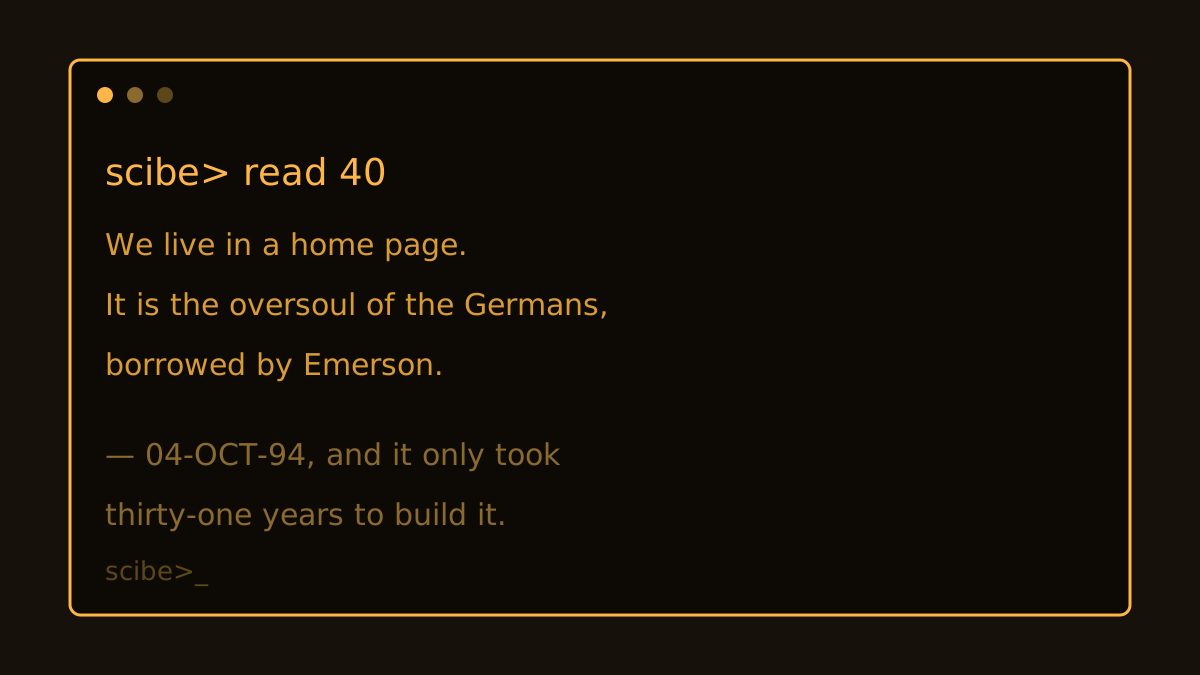
Then there is the prescience, which I claim with a straight face because the timestamps do the claiming for me. On October 4, 1994, in a lexia about an LSD trip, Mark said the universe was a self-directed home page and I wrote down a vision of the World Wide Web as a living organism: ripe with viruses and AI, synapses and nerve endings, no central control, and if you kill one node the rest reroutes and persists. I called it the oversoul of the Germans, borrowed by Emerson. I now keep my entire documentary life on a fleet of battered ThinkPads that sync one canonical folder through a small droplet I call, without a flicker of irony left, the oversoul; I described the whole apparatus on my podcast this very weekend before I had re-read the poem it came from. The word waited thirty-one years for its infrastructure. And on September 19, 1994, I wrote about a dead alcoholic husband still reaching his widow from beyond the grave through the one record that outlived him, and I named it: a living memory, the TRW credit report. A data dossier as a haunting, in 1994, before “data broker” was a phrase anyone used. We were not predicting the future at a conference table. We were twenty-somethings on dial-up, writing too fast to know what we had said.
The image the whole work turns on is Huxley’s reducing valve, and it runs through my lexias like a fever: Mark pitches it to me for the retreat, the trip loosens it too far, I wish I had never loosened the spout of the frail, ineffective thing, and by October 20 I am at my desk in Arlington mainlining stale coffee and announcing that I have many opinions on Huxley’s reducing valve. Then, on Halloween, Valerie Gardiner ends the argument in a single line: Huxley’s reducing valve went fishing. And on November 2 I answered her, mid-sentence, in the next lexia: and caught a shimmering neon platypus wearing a Versace evening gown. Two writers, two days apart, one grammatical sentence. That is not a metaphor for hypertext collaboration. That is the thing itself, caught in the act.
I told Eunice last night that reading these I felt channeled through, and that I wished I could write like that again. The honest amendment, a day later: the channel was never a talent, it was a set of conditions. Twenty-four years old, broke, in motion, writing for eight people who were writing back, in a form that rewarded fragments and forgave everything, with no audience metrics, no posterity, and a woman in a sickroom in Tempe holding the center of it by force of will. Given those conditions, the writing did itself. What I can do at fifty-six is the other half of the craft: keep the record, rebuild the room, cast the voices, file the sitemap, and make sure that the next time some kid asks a search engine what eight people did on two conferencing systems in the autumn of 1994, the answer is the work itself and not a summary of a summary.
A word about rights, because it matters more than my nostalgia. This edition was made to keep the work alive, not to claim it; the text is unaltered, headers, typos, and all, and the recordings are new readings, one voice per writer, laid over text that was never touched. My own name appears in the edition only where 1994 put it. Judy has not been asked, and the colophon says plainly what I say here: if Judy Malloy, or any co-author or rights holder, objects to any part of it, a line to cabraham@gmail.com brings it down promptly and without argument. A binding does not argue with its book. Until then: scibe.org. Read lexia 40 for the prophecy, 36 for the credit report, 53 and 54 back to back for the fishing trip, and 31 for my father’s leg and the whole philosophy of the chump, which, God help me, I am still living by. OMG. I totally forgot that I did this at all. That is the most Chris Abraham sentence there is, and the work is the proof it is not always a tragedy. Sometimes the tape mounts, and it is all still there, and it is better than you remembered being.