Last Friday this weblog broke its own rules and published an obituary for a bar. This Friday it does it again, on purpose, and that apparently makes it a series: the second of my nostalgia dumps, the boring brain downloads of a man with aphantasia and SDAM, ranged over the whole past one room at a time. The first dump was Capitol Hill in the 2000s, and its bar ran on the second shift: work, gym, then Zack’s from nine to eleven. This one is Arlington in the decade after, and its bar ran on the first shift, the standard shift, the shift the rest of this town keeps. This is the Tom opus. It is an ode to Tom, an ode to Taqueria, and an ode to the place where I met my very dear friend Jason Gooljar.
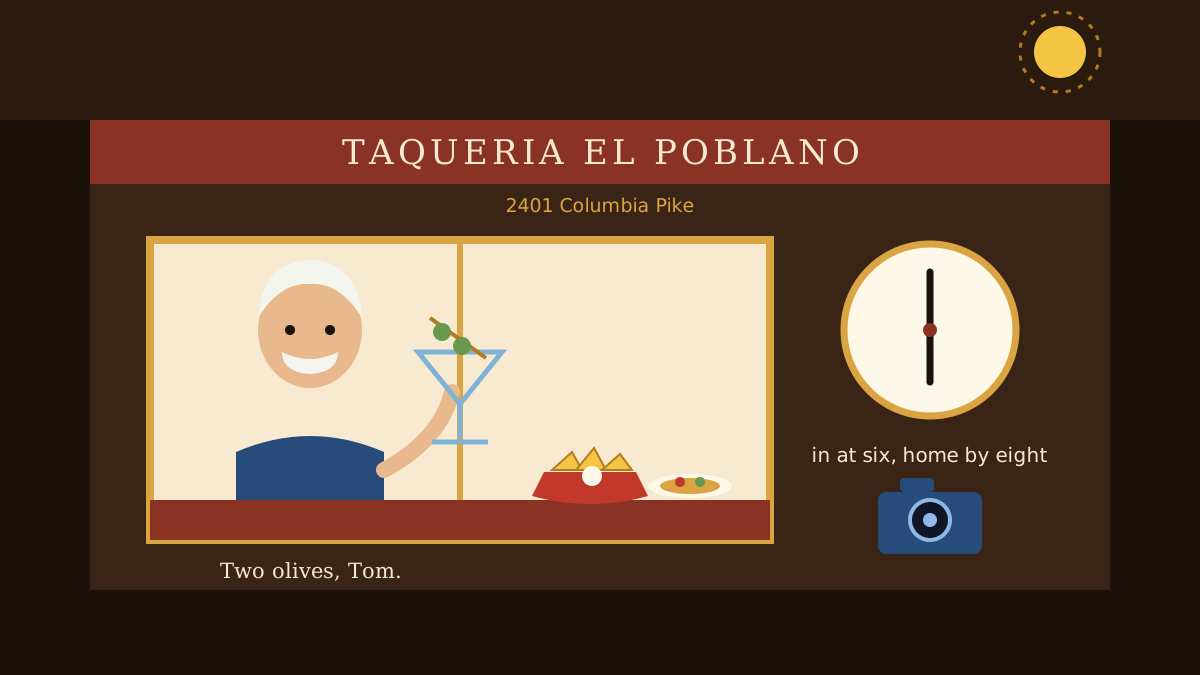
The room is gone, which is the entry requirement for this series. Taqueria el Poblano at 2401 Columbia Pike, in Penrose Square, closed in the spring of 2022, and a tapas bar pours there now. I remembered the manager’s first name and that he was awesome, and I did not remember his surname, because a mind like mine does not keep surnames on tap. It keeps them where it wrote them down. Hold that thought; it is the plot.
The room on the Pike
The Pike room was the third Taqueria el Poblano. The first opened in Del Ray in 1999, and it is open still; the second came to the Lee-Harrison shopping center in 2007; the third opened at 2401 Columbia Pike in 2011, a short walk from my apartment, and it became my local the way a place becomes a local: not by decision, but by repetition. It was a taqueria with a real bar in it, Southern California in its cooking and unhurried in its hours, and for as long as it stood it was where my street ended in the evening. I would see the storefront on my walk, and some evenings the walk bent.
There is a discipline to being a regular that nobody teaches you, and mine was this: the place got an hour or two of me, at the front of the evening, and then it gave me back. I came early, I ate, I drank a little, I talked to whoever was there, and I left while the night was still young enough to be innocent. Other men built second lives in that room. I built a habit, which is a smaller and more durable thing.
Taqueria el Poblano, in order
- Del Ray, 2400B Mount Vernon Avenue, Alexandria—1999 to now. The original, and the survivor; Alexandria still votes it the city’s best Mexican restaurant.
- Lee-Harrison, North Arlington—2007.
- Columbia Pike, 2401 Columbia Pike, Arlington—2011 to spring 2022. My room. Sabores Tapas Bar pours there now.
Six o’clock
My pattern at El Poblano was the standard DC pattern, the one the whole town runs, except that I ran all of it before most people had ordered their second round. I would go in at six and have the happy hour: the tostadas, the basket of nachos and the dip, a margarita or two. Maybe, if I got spicy, a couple of shots of tequila. And then I would leave at seven or eight, and I would be home, and asleep by nine or ten. That was the whole of it, repeated for years, and it never once felt like a compromise. It felt like the correct amount of bar.
I wrote the pattern down years ago, in an essay about my relationship with alcohol, and the essay put it more plainly than memory would have:
“I am usually there between as early as 4PM or maybe six or seven, and then off in an hour.”
Off in an hour. That is the entire doctrine in four words, and I had it at El Poblano before I ever named it at Zack’s. The Zack’s piece last week said Zack’s was the only place that I had sustainability at, that it never burnt me out and never made me feel like an alcoholic. Sitting with that sentence for a week, I have to correct its scope: that is the same thing I had at Taqueria el Poblano. Two rooms, two decades, two shifts of the same happy hour—six to eight on the Pike, nine to eleven on the Hill—and in both rooms the same arrangement: a bounded visit, a known barman, a drink with a name, and home like an adult. Sustainability was never a property of the bars. It was a property of the leaving.
The same essay explains where the doctrine came from, and it was architecture, not willpower. I kept nothing in the house:
“I don’t like to keep any wine, beer, or liquor in the house…If I want a drink, I need to go out to buy one bottle of wine or one Tomtini.”
No bottle at home meant no drinking at home, and no drinking at home meant the drinking had an address, a bartender, and a closing time of one: mine. The bar was not where I went to lose control of the evening. The bar was the control—the rationing device with stools. A man who has to put on shoes and walk past a storefront to get a drink has built himself a governor, and the governor’s name, on Columbia Pike, was Tom.
I was just the barfly that would come in for the discount happy hour.
And I was, let the record show, only that: the barfly of the early shift, a creature of the discount and the basket. The room had a deeper life that started around the hour I went home, and I knew its citizens the way you know the cast of a play you only ever see the first act of. Which brings this ode to its two citizens.
Tom
Tom ran the room. Thomas “Tom” Stevens, co-owner of Taqueria el Poblano and its manager—the manager half of the founding pair, as Arlington County’s own business profile puts it: the founder and chef, Glen Adams, “met his business partner Thomas Stevens while working together for a restaurant group as chef and manager.” Chef and manager. Adams had the kitchen; Tom had the room; and the room, in the years it was mine, had white hair and a mustache behind the bar and a standard of welcome that I have measured other bars against ever since.
My visits were conditional, and the condition was Tom. I wrote that down too, in the same essay, and it is the best paragraph anybody ever wrote about the man, so here it is as I published it then:
“Maybe, once a week, I’ll drop by Taqueria el Poblano and, only if Thomas is there, I’ll drop in and order a Tomtini from him. A Tomtini is just a dry gin martini made by restaurant manager Tom. Two olives. That’s a once-a-week or a once-a-month kind of thing. It’s always based on the serendipity of seeing his white hair and mustache through the storefront as I walk past (and if the bar seating isn’t too packed). If Earth Day Jason is there, I might get a tequila, sometimes two, but I am mostly a one and done.”
Read what that paragraph actually describes: a drink that existed only when one specific man was working, ordered only if his hair was visible through the glass, in a seat that had to be free, on a walk that happened to pass. A Tomtini was not on any menu. It was an appointment you could not schedule, with a martini as its minutes. That is what a great barman does that a great bar cannot: he makes the drink a function of his presence, so that getting it feels like luck and losing it, when the place closes, feels like bereavement. I have had martinis since, in the years when I still drank. I have never had another Tomtini. There was exactly one source.
What I knew of Tom’s life outside the room fits in one breath, and I offer it as I remember it, hedges attached, the way this series keeps its uncertainties: he had a big old pickup truck; he had a fishing boat, and he used to take it fishing on the Chesapeake, I think; and he had a hot hatch, I think it was a Hyundai Veloster or something like that. That was his entire life, as far as the barfly of the early shift ever learned it: a truck, a boat, a quick little car, and the room he ran. It is not a biography. It is what a regular gets, and regulars should say so rather than invent the rest. The man who staged my evenings for years gets his privacy in death of the business, the same as he got my custom in its life: what he showed the room is what the room gets to keep.
A Tomtini is just a dry gin martini made by restaurant manager Tom. Two olives.
The secret nachos
Every regular keeps one secret and tells it exactly once, in public, for the record. Mine is in my Yelp review of the Columbia Pike store, written in my Elite years, and it outs the room’s best off-menu fact: “I’m letting out the secret: not on the menu but there’s an amazing secret nachos!” The store’s own Google questions and answers corroborate the barfly: “Secret nachos do exist. All you need to do is ask! Ask the bartender and Tom.”
Ask the bartender and Tom. Notice the grammar, because the grammar is the ode in miniature: the bartender, and Tom, listed as two separate authorities, as if Tom were not a bartender but a department. In a sense he was. The nachos were secret the way everything good in that room was arranged—available to anyone, advertised to no one, dispensed by a man who knew your face. You did not need a password. You needed to have shown up enough times that asking felt like a sentence you were allowed to finish.
Earth Day Jason
And then there was Jason. Jason Gooljar—Earth Day Jason, in my essay’s naming, the Jason of the tequila clause. Where my relationship to El Poblano was an hour at the front of the evening, Jason’s was the whole evening and then some. Jason stayed until everybody was drunk. Jason became an integral part of the culture of the place: he was invited to people’s weddings; he was admitted to the sanctum sanctorum, the inner room of the room, the one that forms after the barflies go home. I watched that happen from the shallow end, with genuine admiration and no envy worth the name. He had the sustaining power. I had a bedtime. Both of us were regulars; we were just regulars of different countries that happened to share a bar.
Jason is my nemesis and my buddy, and the order of those nouns rotates depending on the week. We are completely on the different side of the spectrum politically—not adjacent, not shades apart, opposite—and for whatever reason we have so much fun having political conversations. Ours is the old arrangement, the one this town used to run on and has largely forgotten how to have: the argument as a form of affection, the sparring match as the friendship’s gymnasium. I have lost friends over politics the way other men lose umbrellas, carelessly and constantly. Jason and I have argued for years and lost nothing. The bar deserves some of the credit. It is hard to excommunicate a man you have watched hold a room together until last call.
And there is the second pleasure, the one that has outlasted the bar itself: it is so fun to watch him become the best photographer I’ve ever known. The man who belonged to El Poblano turned out to have an eye that belonged everywhere; the regular who stayed latest now shows up in my life as images, made by the best photographer I have ever known, full stop, no hedging on that one. The bar closed. The friendship kept its hours. Jason still stays until everybody is done; now he just does it with a camera.
The two regulars
- The barfly—in at six, tostadas and a margarita or two, gone by eight, asleep by ten. Knew the secret nachos. Never saw the inner room.
- The institution—in for the duration, woven into the culture, invited to the weddings, admitted to the sanctum sanctorum. Became the best photographer I’ve ever known.
What the record kept
The end, as the record has it: ARLnow covered the closing in the spring of 2022—“Taqueria el Poblano is closing its Columbia Pike location this spring”—and reporting surfaced with that coverage has Tom Stevens himself handling the closure and the lease transition, the manager seeing his own room out the door; that detail I pass on as the coverage had it, the article itself being one I could not pull up to re-read. The listing says permanently closed. Sabores Tapas Bar serves the address now. The Del Ray original, the 1999 room, is open tonight, and Alexandria still ranks it first among its Mexican restaurants—the chain survived my room, the way the Tune Inn survived the Zack’s row. Institutions and originals endure. The middle children, the neighborhood rooms, the ones that were somebody’s local, are the ones that vanish.
And the surname, since this series has made a discipline of showing its work. When I dictated the wish for this piece last Friday, I had a first name, a mustache, and a drink. Finding “Stevens” took one county profile and one search of my own archive, and the archive is where the comedy is: my own essay, published years ago, had called him Thomas all along, in print, under my byline, while I stood in 2026 telling my phone that I needed to find Tom’s full name. I love the fact that I’m the source for most of my memories. A man with SDAM does not remember his life; he looks it up, and if he was wise in his thirties and forties, he wrote it down where the looking is easy. The Tomtini paragraph was written by a younger man who did not know he was keeping minutes for an obituary. He was. They all are, the things I wrote. That is the whole method of this series, such as it is: I am my own archive, and the dumps are just me, reading myself back, one closed room at a time.
I don’t drink anymore; that is public, and settled, and not the subject here. The subject is what the drinking years, run at my dosage, actually were: an hour at six on Columbia Pike, tostadas and a secret plate of nachos, a martini that existed only when a white-haired man was behind the bar, and a friend across the political universe staying till the end of the night so I never had to. Tom kept the room. Jason kept the night. I kept the record, which turns out to be the only one of the three jobs still open.
So: an ode to Taqueria, which fed a street. An ode to Jason Gooljar, my nemesis and my buddy, who belonged to it entirely and argues like it still matters. And an ode to Tom—Thomas Stevens, truck, boat, and hot hatch, white hair and mustache through the storefront glass—who was awesome, in the plain sense this series insists on: a man doing a job so well that a regular, decades of rooms later, still measures welcome by him. Two olives, Tom. Wherever the boat is, tight lines.